Chronotopia is an industrial nation in Nordika built in the foothills and mountains neighboring the mountainous Forbidden Zone known as Bosch, and next to the chaotic lands of Sylvania, Titania and the Vykarin Wastes. Chronotopians religiously devote themselves toward order in the face of chaos, and this is symbolized by the ever-present Chronotopian clock to be found on most any building of note, carefully kept in sync with the standard set by "Great Gretchen" in the capitol of Blitzheim.
Chronotopia lives in the shadow of the madness of Bosch, and with the threat of invasion by raiders from Titania or its other neighbors. Out of necessity, it is a very military-oriented culture, and many of their mechanical inventions are of martial design. Still, Chronotopia produces a great number of mechanical gadgets for trade with the other nations, even though it is a nation on the surface. Wind-up toys, musicboxes, shekelodeons and pocket watches ("Chronotopian eggs") are pretty much given to be of Chronotopian origin.
2.0 Major Locations
Chronotopia is located in the region known as Nordika, on the northern part of the
continent of Ai. It is north of Bosch, bordered on the east by Titania, on the
north by the Vykarin Wastes, and on the west by Gallis/Sylvania. It is geographically
close to Kroz and Olympia, though the fact that Bosch cannot be safely
travelled over serves to isolate Chronotopia from casual exchanges with those
countries. Chronotopia is particularly mountainous where it is closest to Bosch,
toward the south, though it levels out toward the north.
2.1 Blitzheim
This is a city of clocks, of steam-powered or clockwork contraptions, and all sorts
of mechanical wonders. It's also a place where there are frequently boiler
explosions or other accidents, and it's therefore home to what is probably the
best non-magical fire response system on all of Sinai.
2.2 Gutenburg
2.3 Auschlander Keeps
These fortresses and watch posts are stationed at the far fringes of Chronotopian
lands, and their positions describe the border of the nation. Those in less
contentious spots exist largely for the purpose of symbolic claiming of lands,
but most of them have a very real chance of conflict with invaders, or else see
some "action" as a stopping point for those who wish to enter Chronotopia by
land. (Since Chronotopia will not permit slavery in its borders, it will go so
far as to insist that an airship with so much as a single slave on board must land
outside Chronotopia's borders, and that the slaves must be left on board, if the
ship is to do any business in Chronotopia. Therefore, some makeshift airfields
have sprung up just beyond the border, within a bowshot of the nearest Auschlander
Keep.
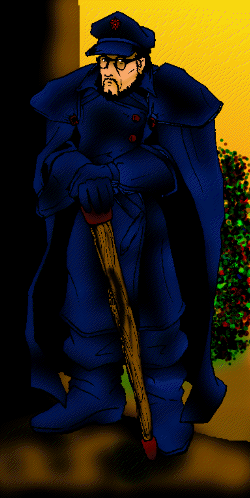
Auschlander Keeps are manned by the Landsknechts, an order of chivalrous warriors
serving the ideal of the greater good of Chronotopia. These outposts are at the
far reaches of Chronotopia, often beyond any semblance of civilization, and
therefore are fairly lonely stations, with the everpresent danger of attack.
There have been stories of Landsknechts driven mad by the influences of Bosch
without ever seeing a single imp or monster, and turning on their comrades, when
magic grows strong in the land.
3.0 Major Species
Chronotopia is a mixed-species nation, though in smaller settlements they tend
to "ghetto-ize", with small towns being comprised of families of members of a
single species for the most part. Only in the larger cities, where there is
enough of a population base to support each species from generation to generation,
is "special diversity" found.
It should be noted that, while this is a multi-species nation, and there are
occasionally visitors from other nations, Chronotopians tend to be wary of anyone
who resembles a Titanian. While a Gallisian or Rephidimite poodle won't be mistaken
for one, Jupani sometimes can get less-than-premium treatment, especially if they
don't speak Bosch fluently. Likewise, very large Khattas may be mistaken for
Titanians. Rhians, though sometimes being large enough to fit within Titanian
standards, are well accepted, since they already have a sizeable population base
in the area.
Reptiles are very rarely found this far north, given the harsh winters and the
high altitude. Kirigas, though by no means common here, are the most likely of the pseudo-reptiles to be able to tolerate the climate.
Until about 6100 RTR, Savanites were not permitted in Chronotopia. Slavery is not permitted in Chronotopia, and banning Savanites entirely from entering the country was mainly done to appease Rephidim, lest Chronotopia become a haven for runaway slaves. With Captain-Astromancer Tahir Archalaus' banning of slavery in Rephidim, and with the Savanite settlements growing in neighboring Sylvania, the young Kaizer Jael revoked the ban on Savanites in Chronotopian lands, though he still reaffirmed Chronotopia's ban on slavery. Since that time, a few Savanites have ventured into Chronotopia in search of new lives, but not in great numbers, since the free nation of Xenea, formed a couple of years later, poses an alternative. Still, a number of the Savanites who settled in Sylvania have ventured over into Chronotopia, trying to flee Gallisian expansionism, and seeking work in the more industrialized nation.
3.1 Cervani
The predominant sapient species to be found in Chronotopia is that of the Cervani.
These "deer-morphs" are digitigrade humanoids, usually lacking human-like head
hair (though this is not unheard-of). The males have antlers, and, out of
consideration of tall antlers (or tall Rhians), architecture in the cities (and
in Cervani-dominated settlements) tends to have high ceilings and tall doorways
to save Cervani the embarrassment of having to duck to get through. (Due to
the expense and trouble of making such accommodations, though, this is not always
the case for homes built with shorter species -- such as Khattas, Humans or
Korvs) in mind.
Cervani are vegetarian, and this impacts Chronotopian cuisine considerably. While
meat is a staple to some of the species of Chronotopia, any worthwhile inn is
also going to have plenty of dishes catering to vegetarian tastes as well.
The military and political leader known as the Kaizer has traditionally been a
Cervani. Supposedly, the Kaizer is elected by Parliament, but this is more of a
rubber-stamping procedure. By tradition, the Kaizer is typically succeeded by
one of his sons (and, therefore, it will just as typically be another Cervani).
It has been noted that Cervani have a natural tendency to be resistant to magic,
and considering Chronotopia's anti-magic struggle with Bosch, this could be
connected with their prominence in this land.
3.2 Human
Chronotopia is home to one of the largest concentrations of humans to be found on
Sinai. Despite the cold winters and northern location, many Chronotopians have
tanned or dark skin. But then, it is not unheard-of for a Chronotopian to have
blue hair, either. There isn't really anything seen as unusual about this -- After
all, how many humans are there to compare them to? This is probably due to the
effects of Quantum Uncertainty. Despite myths in some Sinai cultures of
"human oppression", Humans are distributed across all strata of Chronotopian
society, from working class to the upper class.
3.3 Khatta
Chronotopia has a large Khatta population, the bulk of these having black fur,
similar to the tendency in neighboring Sylvania. However, other types of Khatta
can be found in Chronotopia as well, though the larger "wildcat" varieties are
especially less common, since they can sometimes be mistaken for Titanians, and
therefore have a harder time fitting in comfortably.
3.4 Korv
Korvs are in abundance in Chronotopia, primarily of the crow/raven variety, though
the magpie and jay variations are occasionally found as well. Korvs are the primary
fliers to be found in Chronotopia, and are widespread enough that most buildings
in the city have Korv perches along with more traditional chairs for seating, and
often have "flier landings" on upper balconies. (They don't generally have
landing places on the rooftops, since, with the everpresent possibility of heavy
snow, Chronotopian rooftops are always peaked.) Due to their light bone structure,
Korvs aren't really suited to manual labor, though their ability to fly makes
certain that they are still found in the military.
Rhians represent one of the smaller population groups to be found in Chronotopia,
most of them descended from refugees from Sylvania, and mostly found in rural areas
toward the west side of Chronotopia. Their considerable strength, however, makes
them valued laborers, and therefore they can be found working alongside Humans and
Khattas in manual labor jobs in the cities. Rhians in positions higher than the
working class, however, are fairly rare, largely due to the (not entirely without
justification) stereotype of the average Rhian male of being strong and
slow-witted.
4.0 Major Languages
Languages known in Chronotopia tend to be Nordikan in origin. It is typically
more likely that a traveler will find a Chronotopian who knows at least a
smattering of Gallisian, Krozite or formal Krozite than Khattan, Babelite (Eeee)
or Imperial. This would be true even if the Chronotopian in question happened
to be a Khatta. The primary exception to this would be Rephidim Standard: If
a Chronotopian knows a "foreign" language, it will most often be Rephidim
Standard.
4.1 Bosch
The national language of Chronotopia is known as Bosch. This may be considered very
ironic that the language is named after Chronotopia's worst enemy, but there are
obscure references in ancient Chronotopian texts that hint that the region presently
known as Bosch might have once actually been considered part of
Chronotopia, before some sort of cataclysm brought it to its current state.
It has been noted that Chronotopia's national tongue is almost identical to the
language of the "Kampfzengruppe" soldiers from Abaddon. It is often seen by
outsiders as a very "harsh"-sounding language, and seems best spoken by humans.
5.0 Religion
The primary religion to be found in Chronotopia is the veneration of a deity known
by several names, most notably as "The Great Gear" or the "Prime Mover", a creator
god of order and justice.
More Details on Chronotopian Religion
6.0 Technology
Chronotopia is subject to the same problems with Quantum Certainty that other
cultures on the surface of Sinai have to deal with, but they have dedication and
determination in their favor.
By means of nigh-religious devotion to maintenance and
cleaning of existing machines, and redundant systems in new ones, they can keep
things running. However, a Chronotopian device in the hands of an outsider is
still prone to breakdown if they don't show such dedication to maintenance.
Chronotopians have been doggedly trying to make machines
work on Sinai for centuries. They've learned how to overcome many of the "quirks"
of Quantum Uncertainty, at least in mechanical design. They still can't approach
the electrical accomplishments of the Technopriests of Rephidim Temple, but
some Chronotopian "mad scientists" have nonetheless experimented with machines
meant to "harness" the power of lightning now and then. (And Blitzheim is as good
a place as any to try that, given its reputation.)
6.1 Air Rifle
One weapon in the Chronotopian arsenal, requiring constant maintenance, is the
air rifle of the Luftrittern (the all-Korv air soldiers). This weapon works by
pump action, able to fire a small projectile by means of pressurized air. They can
be used to fire non-lethal pellets for crowd or animal control, or else sharp
darts.
They don't pack anywhere near the firepower of Rephidim flintlocks, but they don't
have a tendency to explode, and they can be safely taken to the surface without
mishap. Also, they don't have much in the way of "kick-back".
6.2 Chronotopian Egg
6.3 Drokarless Carriage
These are motorized buggies, making use of small steam engines ... or, as it's more
often put, it's a steam engine on wheels, with a place for the driver to sit.
The bulk of such vehicles is taken up by the engine and its fuel, and typically
there's only room for the driver, and perhaps a single passenger at most. These
vehicles are typically uncomfortably hot to drive on, and have a tendency to break
down frequently. They are more a matter of novelty than practicality at this
point.
6.4 Juggernaut
On the other end of the spectrum, are the very large steam-powered tanks used by
Chronotopia as a response to Titanian titan machines. Juggernauts have crews
ranging from four to twenty-four. They're slow, inefficient, and difficult to
maintain, so they are only pressed into action when absolutely necessary. The
largest Juggernauts make use of steam cannons, but most simply haven't the room
or power to be able to mount such weaponry. Instead, many Juggernauts serve only
to slam into Titanians (and titans), as armored troop carriers, or as mobile
barricades.
6.5 Quantometer
A similar premise works for a quantometer, except that it works by having two
different simple mechanisms in the device that are normally in sync with each other,
but are known to be affected differently by Quantum Uncertainty. By observing how
far they get out of sync with each other, once can get a rough idea of how high
the Quantum Uncertainty is in the area. In areas of especially high Quantum
Uncertainty, though, such as in certain Forbidden Zones, quantometers have a
tendency to break down entirely.
Due to the known decrease in Quantum Uncertainty with altitude, quantometers are
sometimes used as altimeters, in the same way that a barometer (which measures
air pressure) is used to roughly determine altitude on Earth -- though it requires
periodic calibration while on the ground, since air pressure changes with the
weather. Quantum Uncertainty readings don't tend to change as much as barometer
readings for any given fixed location, so quantometers are often used alongside
more conventional altimeters in Chronotopian airships, as a sort of mechanical
"second opinion" on elevation.
6.6 Shekelodeon
Once wound up (with a hand crank) and activated by inserting a coin, shekelodeons
typically act like miniature stages, telling a story by use of mechanical parts
that move around to represent characters, locations and events, typically with
an integrated "musicbox", and other noisemakers for "sound effects". Most
shekelodeons are no larger than a puppet stage, but there are some amusement parks
in the larger cities (such as Blitzheim) with areas devoted to giant "shekelodeons",
some of them approaching the size of a real stage, and requiring a more practical
power source than a hand crank. These typically require multiple shekels to
operate, often with life-size (but stationary) mechanical dolls, and better music
and sound effects (often utilizing mechanical bellows attached to wind instruments).
The small coin-operated shekelodeons are simple enough that they typically require
very little in the way of maintenance, though the giant "stageplay" variety take
constant attention to keep running.
7.0 International Relations
Chronotopia's general populace may not have much to do with other nations, but
its leadership has become increasingly involved in the international scene,
especially in recent years when the all-encompassing authority of the Rephidim
Temple has been repeatedly challenged, and the status of the current powers that
be (Babel, Nagai) has been called into question. Chronotopia's anti-slavery stance
has often put it at odds with the major powers, but Rephidim's banning of slavery has removed this barrier between the two nations.
During the Coalition War, Chronotopia joined the side of Rephidim, along with most of the Nordikan nations, putting itself at odd with the Nagai/Babel Coalition.
7.1 Ashdod
Chronotopia has no real dealings with Ashdod, since it's a continent away, but its position in the Coalition War means that it technically is an enemy of Babel.
7.2 Gallis
Chronotopian relations with Gallis are, for the most part, neutral. Chronotopia has
pretty much stood by the wayside while Gallis has pushed into Sylvania, not lending
any help or providing any opposition. This is primarily because Sylvania is, at
present, disorganized and chaotic (by Chronotopian standards) and has often
harbored bandits and raiders that have crossed the border to harass Chronotopian
holdings. Gallisian conquest of Sylvania is seen as a way to bring order to
that nation, even though Chronotopians may have mixed feelings about having a larger Gallis as a next door neighbor
7.3 Khattan Emirate
Chronotopian relations with the Khattan Emirate have been pretty much nonexistent
for the most part, until very recent history. With the Titanian "pilgrimages" to
the Red Cliffs, and then the discovery of the Gateway Tower, Chronotopian
leadership has become concerned that Titania might gain some sort of edge by
contact with the Abaddonians -- and acquisition of Abaddonian steel.
Therefore, since the Gateway Tower is located in the Himaat, and the Emirate seems
to be the closest thing to an authority having any part in the Himar region right
now, Chronotopia has begun making overtures toward Abu Dhabi to establish a
presence at the Gateway Tower, and to get involved in the trading for Abaddonian
steel. Of course, black Khatta Chronotopians are those most involved in the
negotiations with the Emir.
The Khattans have been acting as middlemen between the Chronotopians and the
Kampfzengruppe -- the latter seeming especially interested in this (partially)
human nation that speaks the same language, and its ability to adapt machinery
to Sinai.
7.4 Nagai Empire
Chronotopia has had little involvement with the Nagai Empire until the time of the
expedition to the Vykarin Wastes that led to the discovery of (and possible creation
of) Fetiss Sky Island. The Nagai were not used to Chronotopia's policy of forcing
airships with any slaves on board to land outside Chronotopian lands, and this
rubbed a few scales the wrong way.
Furthermore, during a diplomatic function, a
representative of Chronotopia made the mistake of jesting that the Parliament should
lay claim to Fetiss Sky Island, since it came from the Vykarin Wastes and not Nagai.
Despite the absurdity of the suggestion (since Chronotopia does not claim that the
Vykarin Wastes are part of its domain), the joke was taken seriously, and Nagai
quickly moved to demand from the Parliament that it had no designs on the sky
island.
The Parliament, insulted by the nature in which the demand was presented (or
probably just that the demand was made at all) refused to cooperate, insisting
that the whole situation was absurd. When the Empire responded by making thinly
veiled threats against Chronotopian airships ("... should any craft that belong to
a possibly hostile nation come dangerously close to Imperial property..."),
Chronotopia capitulated and wrote up a proclamation that the Parliament had no
claim to Fetiss Sky Island, and that it would make no such claim in the future ...
provided that Fetiss Sky Island and the Nagai Empire would not become a threat to
Chronotopia's security. The Nagai insisted that this last "clause" was vaguely
worded, and hostile, but the Parliament would make no further concessions.
This little tussle may seem petty in the grand scheme of things, but considering
that this is probably the most interaction Chronotopia has ever had with the Nagai
Empire, it leaves relations looking pretty negative at present.
7.5 Rephidim
Chronotopia has regular trade with Rephidim, though it still has a few points of
contention, mainly based on Chronotopia's practice of prohibiting any slaves to
enter the country -- even Temple vessels. The Temple has repeatedly petitioned
for this prohibition to be removed, or at least for there to be special exceptions
for representatives of the Temple on official business. The Parliament has been
stubborn on the issue. Given that the Parliament hasn't gone on the offensive to
chastise Rephidim for the immorality of slavery, some cynics suggest that this
stance is simply in order for Chronotopia to hang onto a symbolic gesture of
defiance, so that its people can believe themselves independent, rather than
subjects of Rephidim.
Despite this issue, relations between Rephidim and Chronotopia are fairly positive
for the most part. Technopriests from the Temple often travel to Chronotopia in
order to study how machines can work on the surface (and how they can't).
8.0 Government, Military and Law
Chronotopia is a very military-oriented nation, and the lines between law
enforcement and military are frequently blurred. While there are courts, there
is no true "due process", and while lawyers may be called forth, there is typically
only a judge -- or a panel of judges at best -- not a jury.
Unlike many nations,
Chronotopia is not quick to head to the chopping block. Those scheduled to be
executed typically sit in jail for a while first. Part of this is so that several
criminals can be executed at once in a public display. Another part of this is so
that there is some time for additional evidence to arise, should it be that the
case wasn't dealt with properly. Still, death is meted out quite often as a
punishment for severe crimes. Imprisonment is typically only for a relatively
short term -- a few years at the most -- never "for life".
8.1 Kaizer
The Kaizer is the military leader of Chronotopia, at least in theory, though his
generals and advisors do most of the business of keeping things going. He is more
a symbolic leader of all Chronotopia, in a position to make proposals to the
Parliament, but unable to simply act as a tyrant and pass decrees without their
approval.
8.2 Parliament
The Parliament is the ruling body of Chronotopia serving as a council to pass and
revise legislation, to determine budgetary matters, and to dictate foreign
policy. While the Kaizer is the single most visible person in the government of
Chronotopia, the Parliament is (for the most part), the real power.
8.3 Landsknechts
Landsknechts typically
have to provide their own armor, so there is no distinct Landsknecht "uniform".
Landsknechts sometimes serve as peacekeepers to try to quell feuds between the
noble houses, and sometimes they act in a capacity as law enforcers. They are
also expected to come to Chronotopia's defense in times of war, alongside the
regular army.
9.0 Trade and Economy
Chronotopia has its low points, but it is a fairly vibrant nation as far as
surface countries go, with a very high standard of living that rivals that of
Rephidim.
9.1 Currency
The omnipresent Rephidim Temple shekel is considered legal currency in all the
cities of Chronotopia. In the rural regions, where shekels might not be
accepted at face value, barter typically reigns. The Parliament has a large
store of precious metals kept securely locked up, and issues printed promisory
notes that can be exchanged for a set amount of silver. These notes are available
in various denominations, the smallest being approximately equal to one shekel
in value. (Exchange rates may vary, but they tend to balance to a 1:1 relationship
to shekels.) A special paper is used with zolk fibers and watermarks for the
making of these notes, to discourage counterfeiting. Due to the blue ink used
in them, and the tradition of imprinting them with images of various inventions of
famed Chronotopian engineers, they're typically dubbed "blueprints", though they
are more formally known as "silver exchange notes", sometimes abbreviated to "silver
notes" or jumbled into "blue notes".
Blueprints are legal tender in Chronotopia, and are accepted in most Nordikan
nations -- though there may be an "exchange rate" tacked on to the price when using
blueprints instead of shekels or the local currency.
9.2 Exports
Major exports of Chronotopia include:
9.3 Imports
Major imports of Chronotopia include:
10.0 Education
Chronotopia has a very high literacy rate in the cities, but this is offset by
a much lower rate in the outlying rural areas. Still, the overall literacy rate
of Chronotopia is competitive with that of the upper-class Nagai in the Nagai
Empire, the nobility of Gallis, the middle-to-upper class of Rephidim, and the
elite of Babel.
Unlike most nations, Chronotopia has a public education system. The quality of
this education is inferior to that of private schooling just about anywhere, but
the end result is that the average Chronotopian has at least a grade school
level education. (Compared to Sinai overall, that is a pretty significant
accomplishment.) In the cities, high school level education is more common,
with a heavy emphasis on the sciences. The typical middle-class Chronotopian
can read and write legibly (if not with perfect spelling), can do basic math,
and knows a fair deal about physics and the basics of mechanical engineering.
Chronotopia tends to go a bit lax on subjects such as history, or education about
the world beyond Nordika.
It is not uncommon at all for Chronotopians to be tinkerers. Even if a citizen
doesn't consider himself one, he probably has at least a few gadgets around the
house that he has to provide routine maintenance to every once in a while. In
the cities, any given city block is bound to have at least one self-styled
inventor trying yet again to make a gas-less flying machine, or something along
those lines.
Back to Politics: Section 7.6.1
 Blitzheim is the capitol of Chronotopia, home of the Kaizer and of the Parliament,
and also the largest city of Chronotopia. Curiously, it also happens to have the
highest yearly incidence of lightning strikes in all Chronotopia, and quite possibly
in all of Sinai outside of a Forbidden Zone. Storms are very frequent here.
Blitzheim is the capitol of Chronotopia, home of the Kaizer and of the Parliament,
and also the largest city of Chronotopia. Curiously, it also happens to have the
highest yearly incidence of lightning strikes in all Chronotopia, and quite possibly
in all of Sinai outside of a Forbidden Zone. Storms are very frequent here.
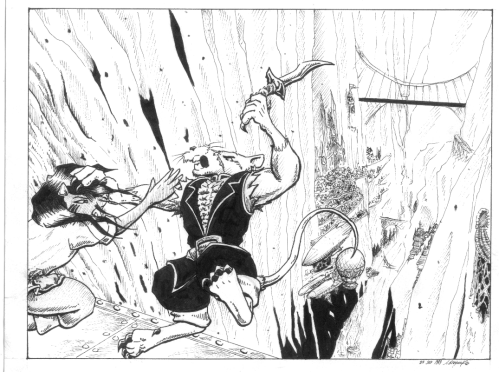 Gutenburg is a city located on the eastern side of Chronotopia, built within a
ravine in mountains that are dangerously close to the barbarian lands of Titania
and the Forbidden Zone of Bosch. Nonetheless, this ancient tear in the earth has
laid bare many veins of valuable minerals, and the river cutting through the
ravine is often panned by prospectors. A mining town has grown into a city here,
connected to Blitzheim by means of a steam-train railroad system. Furthermore,
the ravine offers a natural shelter from storms and strong winds, and an airport
has been built there as well, opening up the possibility of trade with Rephidim
and the other nations of Sinai.
Gutenburg is a city located on the eastern side of Chronotopia, built within a
ravine in mountains that are dangerously close to the barbarian lands of Titania
and the Forbidden Zone of Bosch. Nonetheless, this ancient tear in the earth has
laid bare many veins of valuable minerals, and the river cutting through the
ravine is often panned by prospectors. A mining town has grown into a city here,
connected to Blitzheim by means of a steam-train railroad system. Furthermore,
the ravine offers a natural shelter from storms and strong winds, and an airport
has been built there as well, opening up the possibility of trade with Rephidim
and the other nations of Sinai.
3.5 Rhian
 These are miniaturized versions of Chronotopian clocks. A clever (and complex)
redundant spring system (which draws upon the technology that makes quantometers
possible) stabilizes the clock's measurement of time despite fluctuations in
Quantum Uncertainty. However, it is still quite possible to "overload" the pocket
watch by taking it into an area of high magic or Quantum Uncertainty -- such as
Bosch. With the discovery of the magic-resistant properties of Abaddonian iron,
though, this may lead to new advances in Chronotopian reliability.
These are miniaturized versions of Chronotopian clocks. A clever (and complex)
redundant spring system (which draws upon the technology that makes quantometers
possible) stabilizes the clock's measurement of time despite fluctuations in
Quantum Uncertainty. However, it is still quite possible to "overload" the pocket
watch by taking it into an area of high magic or Quantum Uncertainty -- such as
Bosch. With the discovery of the magic-resistant properties of Abaddonian iron,
though, this may lead to new advances in Chronotopian reliability.
 The premise behind the quantometer is similar to how certain types of thermometers
work. It's possible to make a thermometer by having two strips of metal, each of
a different type, known to expand and contract at a different rate in response
to temperature changes. They are bonded together in a straight bar at some given
temperature. As temperature rises or lowers, the needle will bend one way or the
other, since the two bars are not expanding or contracting at the same rate. By
how far the needle bends (and in which direction), one can determine the temperature
on a scale.
The premise behind the quantometer is similar to how certain types of thermometers
work. It's possible to make a thermometer by having two strips of metal, each of
a different type, known to expand and contract at a different rate in response
to temperature changes. They are bonded together in a straight bar at some given
temperature. As temperature rises or lowers, the needle will bend one way or the
other, since the two bars are not expanding or contracting at the same rate. By
how far the needle bends (and in which direction), one can determine the temperature
on a scale.
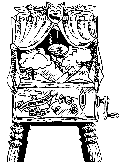 Shekelodeons are mechanical contraptions that gain their name by being activated by
inserting a shekel (or some other coin denomination) to operate them. (They do,
however, suffer from being vulnerable to unscrupulous operators inserting wooden
"slugs" or using other methods to trick the mechanism and get out of paying.)
Shekelodeons are mechanical contraptions that gain their name by being activated by
inserting a shekel (or some other coin denomination) to operate them. (They do,
however, suffer from being vulnerable to unscrupulous operators inserting wooden
"slugs" or using other methods to trick the mechanism and get out of paying.)
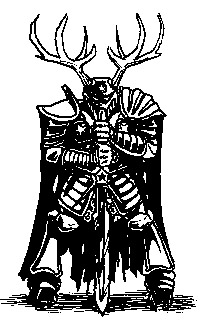 The Landsknechts are glorified soldiers who serve the unified Chronotopia rather
than the various noble houses that comprise it. They are a "knightly" order,
though they are not "knights" in the land-holding sense.
(After all, the name technically means "land farmhand". It does not mean
"land knight", despite the similarity in sound. The meaning of the name suggests
humble origins.)
The Landsknechts are glorified soldiers who serve the unified Chronotopia rather
than the various noble houses that comprise it. They are a "knightly" order,
though they are not "knights" in the land-holding sense.
(After all, the name technically means "land farmhand". It does not mean
"land knight", despite the similarity in sound. The meaning of the name suggests
humble origins.)