Vykarin
Vykarin
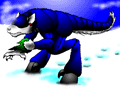 Vykarin are man-sized at the shoulder digitigrade marsupials
with vaguely lupine/armadilloish features, with long legs in relation
to the size of the torso and forearms. The torso leans forward,
counterbalanced by a thick, semi-flexible tail which serves as a
counterweight. The forearms end in hand-like claws with opposable
thumbs, though they are somewhat stubby and not as dextrous as human
hands. The feet are hoof-like with a single sharp "talon"-like growth
on the front of each "hoof".
Vykarin are man-sized at the shoulder digitigrade marsupials
with vaguely lupine/armadilloish features, with long legs in relation
to the size of the torso and forearms. The torso leans forward,
counterbalanced by a thick, semi-flexible tail which serves as a
counterweight. The forearms end in hand-like claws with opposable
thumbs, though they are somewhat stubby and not as dextrous as human
hands. The feet are hoof-like with a single sharp "talon"-like growth
on the front of each "hoof".
The body is furred, but most of the exterior (excepting the underside,
muzzle and paw-hands) is covered with overlapping shell segments. When
the head is upright, the eyes are mostly obscured by a
semi-transparent curved shell which provides some protection at the
expense of clarity of vision. What isn't covered in shell-like
portions has fluffy fur sticking out, usually pepper-grey, lightening
toward the belly.
Due to the physical structure, the Vykarin have some natural armor,
though it is mostly useful to defend against various insect predators
in the region. It is not strong enough to stand up to steel swords and
certainly not bullets. Vykarin are fast runners, slow in turning, and
their stance and hands greatly limit their ability to use tools and
weapons -- especially those humans would use.
The Vykarin are capable of speech, including wolf-like howls,
and the adult voices tend to be very throaty and deep. Their native
tongue includes many distinctive clicks and pops they make when
speaking. Their existence is nomadic as they do not make extensive use
of tools nor of permanent shelter. They do cut pits in the tundra and
pile up chunks of half-frozen ground as windbreak walls while they
curl up inside.
The Vykarin are superstitious, wary of magic, and consider most
technology to be "magic" as well. They have no affinity toward magic.
Any "shaman" in the tribe may have herbal abilities and may have
superstitious notions about talismans and the like, but actual magical
abilities are a unique trait that often results in exile from the
tribe -- or worse.
Vykarin shells are shed and regrown periodically. The cast-off shells
are used to make the jewelry, tools and fragile weapons which this
race is noted for.
The Vykarin tend toward a region of wide open half-frozen
tundra known as the Vykarin Wastes, marked only by the occasional
boulder left by the glaciers.
Vykarin camps can be told by the pits torn up in clusters where the
creatures huddle in for shelter from the winds that whip across the
expanse.
The Language of Vykarin Shell Bead Necklaces
The necklaces worn by Vykarins, fashioned of pieces of shell strung
together as beads, serve a far more important purpose than mere
jewelry. While the spoken dialects of Vykarins have varied so greatly
that any given two tribes most likely cannot communicate with each
other, the "language" of the shell necklaces has remained remarkably
unchanged for innumerable generations.
Each necklace, depending upon the shapes of the beads which run along
its length, and their order, conveys a simple sentence that says
something about the wearer or his tribe. (Most such necklaces are worn
by males, but this is not exclusively the case. "He" and "his" here are
used in the generic sense.)
A Vykarin without any necklace at all is generally either a child, a
common member who has done nothing to distinguish himself, or else an
outcast who has no tribe to verify the claims made by any such
necklace he wears. While each tribesman will have a short vocal name
by which he is called, the accomplishments which are commemorated by
his necklaces are just as much a part of his full name and identity.
If he should lose such a necklace, for certain he will consider it a
high priority to make a replacement as soon as possible.
These necklaces are as often made by the wearer himself as given to
him by members of the tribe ... but those of a particularly boasting
nature are, by tradition, only made by others. Necklaces fashioned for
oneself are most often more fact-based, such as "(I) slay/have slain
(a) dragon" or "(I am a) maker (of) fire" or "(I am the) eldest son
(of the) chieftain". What is worth commemorating is highly subjective.
Being a "maker of fire" may be of real note to some of the northern
tribes -- but to some of the southern ones who regularly set up bonfires
and may even signal airships for trade with the "sky gods", it is
hardly a cause for celebration.
Bead Colors: Color has a limited role in determining the meaning of a
given shell. After all, many necklaces are made solely from one's own
cast-off shells, and except for those individuals with unusual
striations, this will not give much variety in the least ... and even
most tribes tend not to have colors representing the entire spectrum
of possible hues among their number. In terms of meaning, the color of
a shell is either "light" or "dark". "Dark" is black or very close to
it. "Light" is any other hue. The "darkness" of a shell does not
affect its basic meaning greatly -- Rather, it indicates emphasis. A
darker piece of shell indicates a more important part of the sentence
-- comparable to where you would put the stress if you were to read
such a sentence aloud.
An average Vykarin's shell is not a uniform color, but will tend to
darken in some areas and lighten in others. Shell areas that run
closer to black are less in abundance than the main coloration -- and
hence are used less. The exception to this would be with those Vykarin
with black shells ... and if they make a necklace of their own shell
entirely, the effect is much akin to TYPING IN ALL CAPITAL LETTERS.
As for the choices between using blue or green as "light" colors,
these are ultimately arbitrary and aesthetic. However, it is typical
that if different colors are to be used, there will be some sort of
repeating pattern, or else care will be taken not to have two pieces
of the same color next to each other. This tradition may be of help to
someone who has found, say, an ancient collection of shells which once
formed a necklace, buried at a gathering ground, but which are now
scrambled because the string and bone spacers have long since decayed.
(Vykarin shell tends to be resistant to normal processes of decay. It
can be burned, but doesn't make for very good fuel.)
Bead Shapes: The rough shapes that individual beads are found in serve
as pictograms, in essence. There is some variation in the crafting
that is inevitable, which means that a necklace may require some study
to determine its meaning -- with some help from the context -- but the
shapes are more or less consistent. Individual shapes are rarely
symmetrical, and their alignment matters. To put a piece on backwards
typically spells out the "opposite" of the phrase or word it usually
represents. Good becomes evil, strong becomes weak, masculine becomes
feminine.
Wearing a necklace backwards can lead to some disastrous resultant
interpretations, particularly for simplistic "sentences" that are
nothing but a string of boasting adjectives. "(I am) strong, swift,
fierce, brave, wise (and) masculine" could become "(I am) feminine,
foolish, timid, mild, slow (and) weak".
Bead Spacers: Many words are represented by combinations of smaller
pictograms. Memory, after all, is a concept hard to represent with a
picture. It is represented by a combination of "ear", "circle" and
"night", as memory is exemplified by those who listen to the retelling
of stories by the elders in the evening circle gathering. Many of the
origins of these "conglomerate" words are so obscure that no Vykarin
could explain exactly why they came to such combinations in the first
place -- It is just a matter of tradition.
These groupings are separated by much smaller beads which serve as
"spacers", typically round or cylindrical, hollow through the center.
Some are made of shell, but many are of hollowed bone. In some cases,
teeth or claws are used, typically in conjunction with a message that
boasts of the wearer's conquests in battle -- and it is especially
important that each tooth or claw be as different as possible from the
next, so that one does not infer that these were all taken from the
same victim.
Bead Arrangement: The ordering of the shell words can be very
important. Within each grouping, the arrangement of the parts that
form it can lead to entirely different and unrelated (not simply
opposite) interpretations. If "Strong" is composed of pieces A, B and
C, then "Weak" will be composed of the reversed pieces in the order
of C, B and A.
Ordering is also important with numbers. Representation of numerals,
when applicable, is done in a system very much akin to Roman numerals,
in that units are added to the total or substracted depending upon
their position. Numerals are represented by thin shards of various
lengths, and there are "shepherd" pieces on each side that bound in
the number, and correspond to the value of "10". This is considered
the "most common" value, and serves for comparison with the rest, for
the values represented depend upon the relative lengths of each shard
to the next. Mixing them up can greatly affect that number you end up
with. It's a clumsy system, and does not lend itself easily to
mathwork.
Star Discs
An artifact special to the Vykarin is the Star Disc. It is a complex
construction requiring pieces of many different colors of shell fused
together in a semi-translucent construct, thin and disc-shaped,
durable but still not something to be smashed about carelessly. These
require lots of black shell, as most of the disc represents the night
sky, with lighter, translucent points that represent the positions of
constellations of stars, and often the positions of planets
and the band that denotes Sinai's ring.
Along the perimeter is often a jagged panoramic horizon, dominated by
the silhouettes of major mountains or other rare landmarks visible
from some point on the vast tundra wastes in the distance.
Given some knowledge of astronomy and of the areas of the
tundra, one could determine a particular time and place depicted --
especially since most star discs are made to commemorate or refer to a
relatively rare cosmological event such as planetary
alignments or formations, or the appearance of a comet. The place can
be determined, theoretically, by triangulating from major landmarks
represented on the "horizon", and by what stars are visible, as
painstakingly rendered by the artist. (This is evidently not an art
done on the fly.)
These discs, if they do not commemorate some particular event of note,
are often used as a reminder of the location of a site sacred to the
tribe and which the tribe will visit once in a great time --
corresponding to a rare but repeating cosmic event. Many tribes with
common ancestry will converge upon these ancient ruins at such rare
times -- and these gatherings often skip several generations. This is
a time for feasting and celebration, for exchange of gifts between
tribes, sharing of tales, remembrance of the dead, and sometimes the
creation of new tribes. Any Vykarin born during such events are
considered blessed by a special omen, and destined for greatness.
These sites are typically archaeological gold mines, as well as
exhibiting magical residue and/or signs of ruins of ancient,
prehistoric structures. Whether these may have once been Vykarin
cities -- or cities of some greater race that ruled or spawned the
Vykarin -- is anyone's guess. In any case, the traditions are
faithfully followed, and the star discs are created with as much care
as any Vykarin could put into such work.
Smaller and cruder versions of star discs sometimes appear in
necklaces of especially accomplished individuals, serving as a means
of indicating time and place in addition to whatever claim is being
made or event commemorated by the necklace, and they are typically
worn in the center of the necklace as an amulet. The accuracy of such
testaments is typically far less than the star discs, especially since
these amulets are smaller in size.
Abaddonian Vykarin:
Some Vykarin variants have been found on the world of Abaddon, and in the Red Cliffs that were transported from there. These Vykarin serve the Abaddonian Silent Ones, and are pretty much comparable to Sinaian Vykarin.
PC Requirements:
4 pts Natural Armor: Chitin-Like
1 pt Running: short-distance runner (can run a mile in 7 minutes, up to 10 miles)
1 pt Resistant to Poisons/Toxins, they prefer strong drink and
often eat disease-laden creatures such as vermites without problems
1 pt Resistant to Cold Environments
-1 pt Disadvantage: incapable of fine manipulation or using many human-type tools and
weapons due to their crude hands
Recommended Abilities (Sinaian Vykarin):
Skills appropriate to hunting, tracking, survival, etc. are
appropriate, especially for the males. Crafting abilities (using
bits of cast-off shells) are especially appropriate for the
females. Elders in the group may have some skill at astronomy, as
knowledge of time and the position of the stars is a trait common
to the nomads in order to plot their way across the tundra, which
is greatly lacking in distinctive landmarks.
Back to Section 2.1.28

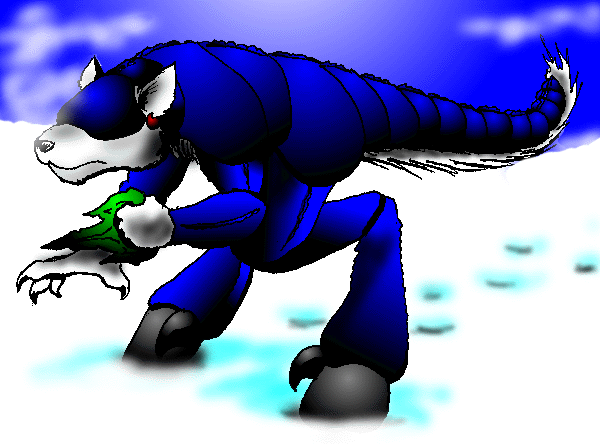 Vykarin are man-sized at the shoulder digitigrade marsupials
with vaguely lupine/armadilloish features, with long legs in relation
to the size of the torso and forearms. The torso leans forward,
counterbalanced by a thick, semi-flexible tail which serves as a
counterweight. The forearms end in hand-like claws with opposable
thumbs, though they are somewhat stubby and not as dextrous as human
hands. The feet are hoof-like with a single sharp "talon"-like growth
on the front of each "hoof".
Vykarin are man-sized at the shoulder digitigrade marsupials
with vaguely lupine/armadilloish features, with long legs in relation
to the size of the torso and forearms. The torso leans forward,
counterbalanced by a thick, semi-flexible tail which serves as a
counterweight. The forearms end in hand-like claws with opposable
thumbs, though they are somewhat stubby and not as dextrous as human
hands. The feet are hoof-like with a single sharp "talon"-like growth
on the front of each "hoof".