There are many religions to be found on Sinai, and of any given religion described here, there are many variations and sects beyond those "mainstream" examples presented -- to the point where it's impossible to list them all. After all, an adventurer may encounter new cultures while exploring the unknown. There is more yet to be discovered.
That said, there are several religions on Sinai that have been introduced during the course of adventuring, some of them influential, some of them not quite so influential. Here is a rough overview of some of these faiths. Some of them are described in greater detail in other sections of the Players' Guide -- especially under the entries for the cultures in which they are prominent.
1.0 Sky Gods
While there are many nations and cities, there are far more scattered
nomadic tribes and small settlements with minimal if any contact with
outside cultures. Their languages tend to be highly deviated versions of
more common Sinai tongues, and their religions vary greatly from tribe to
tribe. However, there are some recurring features of the "stereotypical"
tribal belief system that can be found all over the globe.
One of these features is a belief in the "Sky Gods", particularly among
those species without flight ability. It is not terribly difficult to
impress such "primitives" with airships, or simply by virtue of being
a species that the natives haven't encountered before -- especially if
the species in question happens to have wings. This is a risky business,
since one runs the risk of being mistaken for a devil as oft as an angel,
so to speak, but there are unscrupulous traders who have made a living
by seeking out such "pocket cultures" and exploiting their naivete by
capitalizing on this -- though it should be noted that pickings are rarely
bountiful with the surface tribes, as their lives are harsh and their
resources are few.
After so many ages of practices like this, a good number of the tribes on
the surface near Forbidden Zones have learned that, if they encounter
"Exiles" (which occasionally may just be some hapless wanderer of strange
species who happens to bumble into the area) that they should set out
signal fires and turn the stranger over to the "Sky Gods".
Some tribes have ascribed particular identities to various "Sky Gods",
blending them with other traditions and beliefs ... and the nuances of
these variations may spell success or doom for someone who tries to pass
himself off as a "Sky God", depending upon how close he gets to meeting
their expectations.
It should be noted here that just because someone is primitive doesn't mean
that he or she is stupid. While there may well be cases where the
natives will be so impressed with the "gods" that they'll offer up blood
sacrifices or hurl themselves into volcanos for the promise of riches in
the next life, most of the time they will ultimately have their self
interests -- including self-preservation -- at heart.
(If they were all so easily swayed, there would be
far more treasure-seekers exploiting them, until all of the tribes would
have either caught on or be wiped out by now.)
Many a time there has been
a witchdoctor or shaman or village elder that was shrewd enough to see
what was going on, and would know how to "play the game", pulling up
obscure legends (perhaps made up on the spot) to villify some supposed
"Sky God" throwing his weight around the village, or otherwise sway
general opinion.
2.0 The Star
The worship of the Star might seem at first to be a nearly universal
faith on Sinai, followed by the greatest warriors of the Knights Templar
to the lowliest Savanite slave bringing traditions from the "wild".
However, while worship of the Star generally involves a monotheistic
viewpoint of the universe being created by an omniscient and omnipotent
deity, the exact nature of that deity varies depending upon what
sect of the Star-worshipping faith is doing the explaining.
The core Star belief is basically a genericized quasi-Judeo-Christian
faith, sometimes with more specific elements thrown in. On the whole,
the Star is supposed to be a good and righteous creator of the universe,
and directly involved and interested in the affairs of mortals. The
Star created everything, and it was to be perfect, but the sapient races
were given free will, and in a repetition of failures, they each fell
to temptation, and the world became imperfect. An evil force opposing
the Star and encouraging the corruption of the sapient races is
referred to as "The Darkness", and sometimes more specifically personified
as "The Dark One". There is a concept of an eternal soul of each person,
and an afterlife of paradise with the Star, or being banished out into
"The Darkness".
From this point on, details vary greatly. Some sects believe that the
difference between spending the afterlife in the Light or the Darkness is
based upon how many good or bad deeds one performs -- and just what
comprise really good or really bad deeds varies from point to point.
Others, however, have a concept of asking the Star for forgiveness, and
that being the key to an afterlife in the Light.
There are even some cases where the Star is not worshipped exclusively --
or at all. In the Olympian pantheon, for example, the Star is recognized,
but only as an impersonal "creative force" that got the ball rolling, so to
speak. That's much the same concept that is recognized in the Temple of
Rephidim, though the Knights Templar of the Order of the Bounded Star and
Anchor follow a more "personalized" version.
The Star is known amongst some Savanite tribes, and thus Star-worship has
spread wherever Savanites have been taken into households as slaves,
though exact particulars tend to be influenced by the culture of the
given country that this worship is found practiced in.
Some limited contact has been made with the cultures of Abaddon, and there
has been evidence of worship of the Star (or some similar entity) on that
world, particularly by a culture known as the "Silent Ones". Unlike
scattered Savanite tribes, the Silent Ones actually have a set of holy
books that define their beliefs. However, it has already been discovered
that there may be disagreement in particulars in their ranks. The texts
describing the Star can and have been interpreted in different ways -- while
some emphasize the Star as a loving and merciful entry, other parts of
their holy texts describe a more war-like Star that leads its people to
conquer unbelievers, and who brings punishment to transgressors. It
appears that the more militant interpretation of the Star holds greater
sway in the culture of these "Silent Ones".
3.0 Rephidim: The First Ones
The veneration and worship of the First Ones is based loosely on a notion
that the First Ones had somehow "ascended to a higher plane of existence",
and left the physical realm en masse. There seems to be a concept that
these "First Ones" represent not merely the "first ones" on Sinai, but
the "first ones" to go onto this "greater realm", and that they might have
a hand in helping other races to "evolve" to this next stage of existence.
Literature concerning the worship of the First Ones blurs their identity
with the people known to scholars as the Sifras, owing to the fact that,
once upon a time, nobody knew the term "Sifra", let alone made any
distinction between "Sifras" and "First Ones". Some still debate that fine
point even today.
While "the First Ones" are seen as a who culture of exalted beings
of unknown forms, there can be found "statues of the First Ones" that
serve as focii of worship, and typically look like members of the race of
whomever sculpted such pieces. Some have tried to personify specific
First Ones, turning them into a pantheon of "patron deities" after a fashion,
but this practice isn't really recognized by the Temple of Rephidim.
4.0 Rephidim: Technopriesthood
Deep within the Temple is an area known as the Inner Mysteries, restricted
to any but the Technopriesthood, except in special cases. One of the most
holy sites here is the Diagnostitorium, where the more overtly spiritual
side of this faith is manifested when persons seen to be "malfunctioning"
are strapped to a hydraulic lift and the Technopriests attempt to perform
"diagnostic routines" to determine the problem and exorcise it.
On the darker side of things, heretics and blasphemers are often hurled into
the Scrap Pile -- a sometimes fatal punishment, since the scrap pile has
a great many sharp and jagged edges poking up here and there, and it's a
considerable drop. Entry into the Diagnostitorium without permission is
immediately punishable by instant death, or consignment to the Scrap Pile.
5.0 Nagai: Golden Serpent
In the Nagai Empire, the average Naga is not particularly religious, but
lip service is still given to the "Great Serpent" or the "Golden Serpent"
from time to time, especially in official functions. For the most part,
the Golden Serpent (associated with the sun) is more a symbol of national
pride than a true deity, but some worship it as such. Nagai religion is
not very organized, and there is no official "holy book" or centralized
religious body, so many variations exist ... Sometimes the "Silver Serpent",
associated with the Procession, is added to this little "pantheon", and
others as well.
It is a general belief in the Nagai Empire that when one dies, one is
swallowed by the Golden Serpent, thus being annihilated utterly, or else
losing oneself by "becoming one with the Serpent". There are technical
differences between the two fates, but neither allows for a view of
some "paradise" afterlife. Nagas are thus encouraged to be focused on
the here and now ... or else to seek immortality by other means, such as
by being remembered as a great Naga in one's field of specialty.
More Details on Religion in the Nagai Empire
6.0 Babel: The Seven Sisters
In Ashdod, countless gods and goddesses are venerated and worshipped,
some of them being exalted heroes that were "promoted" to godhood, while
others are personifications of natural forces or (as is repeated in many
magic-using cultures), the Spheres of Magic. Which particular gods or
goddesses are worshipped in a given area varies greatly, but the most
widely recognized deities of the Babelite pantheon have their centers of
worship in Babel, and are fairly representative of the natures of most
Babelite deities.
These would be the Seven Sisters, seven goddesses that are depicted as
young, beautiful, female Eeee. (Well, they're beautiful by Eeee
standards, anyway.) Each goddess is associated with a different mountain
in the range that Babel is situated in, and each goddess has a different
"specialty". There are many tales told of the exploits of the Sisters,
though there is no real concern for continuity or consistency. There are
numerous times when one goddess or another was killed or maimed in some way,
yet the goddess pops up for more in another story. Some purists have
attempted to explain all of this and to present a chronology to the
"canon" tales, but the average worshipper honestly doesn't care. Tales of
the Seven Sisters are typically lurid, excessively violent, and generally
devoid of any socially redeeming moral by most standards -- not, however,
by Babelite standards.
Each of the Sisters has a shrine on the mountain that shares her name.
Priests and priestesses (usually the latter) following a given Goddess
are given to professions appropriate to that Goddess' area of expertise.
Donations to the temples are typically given in return for services as much
as for any sort of favor with the Goddesses. In actuality, the nature of
the Goddesses is that they are not to be worshipped so much as appeased,
and in the tales of their adventures, those who gain their attentions
generally just live long enough to regret it.
The Seven Sisters include:
More Details on Ashdod Religion
7.0 Olympia: The Pantheon
The Olympian Pantheon is an example of a Sinai religion developed by
a magic-using culture, where the major gods and goddesses correspond to
the twelve recognized Spheres of Magic. There are many other gods and
goddesses that have been tacked on to this pantheon, most of them
consisting of deities borrowed from other faiths that Olympia has come
into contact with -- modified to better fit their world concept. Thus,
the Seven Sisters are even recognized in Olympia, though they are
presented in such a mild light that they are almost unrecognizeable
compared to their Babelite origins.
The primary Olympian gods and goddesses are all Katthas, given that this
is a land dominated by that species. Legends about these deities have
them squabbling and competing with each other all of the time, in a
never-ending contest to determine who is the best. Like Babelite myth,
there is no real chronology to these events, nor any attempt at
consistency. However, unlike the Seven Sisters lore, the Olympian
deities are considered eternal and immortal, and therefore don't kill
each other off, even temporarily.
The main Olympian deities include:
8.0 Half Valley: Rikkianism
Rikkians can be identified by "holy symbols" they wear, known as Rikkorels.
These are amulets stylistically represent their god, Rik'. (Apparently,
there is a goddess, as well, which the females wear representations of.)
When making prayers to Rik', believers touch the appropriate part of the
body represented by the amulet, which corresponds to the nature of the
prayer. When praying for swiftness, for instance, the feet of the amulet
would be touched.
It is believed that there may be some pockets of belief in this Exile
faith, the largest known instance of this being found in Half Valley.
There, it is reported that a large settlement of Rikkianists had been
preying upon Nagai in the region. Although Half Valley is under the
protection of Rephidim, a Nagai military force moved in, and wiped out the
settlement, though it is believed that many of the Kavis escaped.
The controversial aspect of this faith is that the "Devil" of this faith,
Nakh, is personified as a Naga, and the Nagai as a race are seen as the
"Children of Nakh". Many Rikkianists, therefore, have interpreted this to
mean that Nagas are inherently evil, and that killing them whenever the
opportunity arises is a good and just thing. It is believed that there is
a Rikkianist prophet who has preached against wonton slaying of Nagas, but
he is also believed to be a specialist in killing the snake-people, and
so some Kavis have interpreted this as just meaning that one needs to find
a fairly good reason to kill Nagas. Given how disagreeable and
imperious Nagas are given to be toward "lesser" persons (anyone else)
outside the Empire -- and certainly including Kavis -- it probably isn't
hard to find some sort of "just cause".
As such, the Nagai Empire has pretty much declared war on any pockets of
Rikkianism to be found, and it is similarly unpopular in Babel. A
potential flash point may be in Rephidim, given a large population of
Nagai and Kavi to be found there.
9.0 Chronotopia: The Great Gear
In Chronotopia, the primary religion there focuses on "The Great Gear", also
known as the "Prime Mover", among other titles. There is considerable
similarity between the worship of the Great Gear and that of the Star,
though the Gear enjoys a bit more consistency in Chronotopian worship.
9.1 Church and State
Churches to the Gear are to be found in any town, and great cathedrals in
the larger cities. The Great Gear is a god of law and order, and followers
of the Gear desire to find their particular place in life, in the "Grand
Machine". Although Great Gear theology has concepts of sin and
forgiveness, and of an afterlife of reward or punishment, it is a religion
that has developed a close association with the nation of Chronotopia,
to the point where one does not identify one's faith as a "Gearite" or
some other such title, but simply as a "Chronotopian".
Thus, clocks are, after a fashion, patriotic symbols of Chronotopia, as well
as holy symbols of the Great Gear. Cathedrals typically have gearwork
visible in the ceilings, and sometimes operating on the walls -- decoration
and symbolism more than actual function. Government buildings typically have
similar design concerns.
The dedication with which Chronotopians tend to their clocks, in an ongoing
effort to see to it that they continue to not only function, but be accurate,
is seen as a patriotic and religious symbol. On a patriotic level, it is a
way for the Chronotopians to thumb their noses at the chaos and anarchy
represented by Bosch and by Titanian raiders. On a spiritual level, it
symbolizes the dedication and devotion required to do good in the face of
adversity.
It is small wonder that the state tolerates this particular religion and
indeed celebrates it, for what government would protest against priests who
urge their congregations to be law-abiding, hard-working citizens?
9.2 Differences with Other Religions
Some tolerance is made for the Temple, but only so far as its teachings can
be seen as somehow "the same god, only known by a different name". One
point of contention is that while Temple teachings allow for the practice
of slavery, this is considered illegal and immoral in Chronotopia. Also,
magic is obviously widely used in Rephidim, while it is largely shunned
in Chronotopia -- due to the negative examples set by Bosch.
Some compromise is obviously made here. Chronotopia can be hard-nosed about
its no-slavery policy. For instance, a Temple ship with so much as a single
slave on board will not be permitted to land in Chronotopia. The ship will
have to land just beyond the border, near one of the Auschlander Keeps, and
then the delegation will have to hoof it to the nearest city, leaving any
slaves back on the ship.
Still, Chronotopia is obviously on speaking and trading terms with Rephidim.
Chronotopia hasn't tried to put pressure on Rephidim for its ways.
The "Great Gear" faith has many sects and denominations. Some of them are
more "fundamentalist", while others are more "liberal". As a very rough
generalization, priests of the Great Gear tend to get along better with
religions that are monotheistic, and which promote values that at are close
to those of the Great Gear. Religions that worship multiple gods are seen
as "pagan", and disorderly.
9.3 Symbolism
Clocks and other timepieces also figure into Chronotopian religious
symbolism. Conversely, Bosch cultists within Chronotopian society tend to
pick symbols that are seen as blasphemous: a clock with 13 hours, or with
multiple, crooked hands, or wrong in some other overt way, or else a gear
with mismatched cogs, for instance.
9.4 Celestial Order and Warders
Unlike many nations on Sinai, magic is not practiced, by and large, in
Chronotopia. However, there is a noteworthy exception, in the form of the
Celestial Order (based in the Celestial Monastery). The Celestial Order
trains some of its priests in a very specialized form of magic, drawing
small parts from the Spheres of Spirit, Chaos and Shadow, specializing
solely in anti-magic and wards -- thus becoming known as Warders.
Warders
cannot generate any magical effects or any proof of their magical powers,
except in the presence of magic ... and then, only to suppress and dispel
that magic. Magic is associated with the realm of Bosch, and while
Chronotopian priests may not come right out and call magic evil,
they believe it to be dangerous -- too dangerous. Warders,
ironically, do not consider themselves mages or wizards, but rather
just priests who have learned about how to fight the powers of magic.
Their rituals and cantrips are shrouded in added prayers and religious
trappings beyond that which is actually required to produce magic.
The Celestial Order has its closest association with the Rephidim Temple
by its contributions to the Sanctuary of Order on the fringe of Bosch.
There are many members of the Celestial Order at the Sanctuary, some
Warders among them to travel the Pilgrim's Way and to restore the wards
meant to hold off the chaos of Bosch.
9.5 Deism and the Keepers of Time
"Deism" is sometimes illustrated as believing that God is a watch-maker, and
that the universe is His watch, which He wound up, then left to run on its
own. This idea is often reflected in Chronotopian religion, though it is
more prevalent in some sects more than others.
Namely, on Sinai, with the widespread availability of magic, miracles don't
seem to have so much importance. Mere mortals, after all, are capable of
working "miracles", regardless of their pledged faith. Some Chronotopians
go so far as to think that there simply are no miracles, that though
there is a Creator, or a Watch-Maker, He can't be counted on to meddle in the
affairs of mortals.
This particular illustration has been taken a step further by the Keepers of
Time, who hold to it in a literal fashion. They refer to the Great
Gear as the "Watch-Maker", and believe that the universe is indeed a watch
created ... for the sole purpose of keeping time. Therefore, they see the
keeping of accurate time as a religious imperative.
This sometimes brings them into conflict with other sects, due to the
theological implications of suggesting that the Creator would need
someone to help Him keep track of time (and that He might possibly be late
for an appointment somewhere).
Where there are forces seeking to maintain order, there inevitably emerge
forces to oppose the status quo. Filling this role in Chronotopia would be
the Bosch Cultists, known by countless names, in scattered cells, with greatly
varying degrees of involvement with any real powers of Bosch.
Some cultists are just spoiled rich kids who essentially have formed a "coven"
as a sort of elite club, and as their way of rebelling against parents and
society. Some cultists genuinely have some sort of contact with Bosch, either
through a "touched" member who gets dreams and visions from some force of
Bosch ... or else through direct contact with a monster of Bosch that is
powerful enough to travel outside of Bosch for a limited amount of time to
meet secretly with the "believers".
The activities of Bosch cultists vary greatly, from symbolic pranks (sabotaging
clocks, grafitti, defacing monuments) to subterfuge (spreading rumors), and
all the way up to assassinations, murders and other heinous crimes. Their
actions are usually more symbolic than tactically effective -- they seek to
sow discontent, to make the populace uncertain, to spread fear and misery.
Individual members often seek personal power, typically being promised all sorts
of power, should they prove "worthy" of becoming an Overlord or some other
powerful being in Bosch some day. Some are given "blessings" in the forms of
special powers, enhanced strength, et cetera, granted during a secret "pilgrimage"
to the fringes of Bosch. This almost inevitably comes with some sort of
side-effect, whether it appears immediately, or develops over time. This
side-effect is usually some sort of physical mutation. At first, it may be
easily enough concealed, but if it is discovered, it can give away the
identity of a cultist. Over time, such mutations may grow worse, until a
cultist degenerates into a horrible monster, typically going on a rampage
until finally hunted down by the authorities and destroyed.
Cultists generally aren't given what they're promised. And if they are,
then the old adage of "Be careful what you wish for" is quite applicable.
10.0 Bakanal: Earth Mother
The nature worship in Bakanal is an extreme example of how some "pocket
cultures" -- particularly those with some history of one-time contact with
humans, or who have come into contact with non-anthropomorphic versions of
their races (e.g., Jupanis / wolves, Khattas / cats) -- have developed a
"get back to nature" value system. Many of them originated in more
civilized areas, but were led by some "prophet" to settle in a remote area
and set up their own community.
By all known examples, humans have been excluded from such movements, as
well as those races that don't directly correspond to a non-anthro
Terran species that can be found on Sinai. In Bakanal, this included a
mixture of Jupani, Cervani and Lapi, who settled in an area west of
Himar. (All three species are found in the area.) This is atypical, as
such communities tend to either comprise of members of a single
species, or at the very least, be restricted to those of similar diet
(i.e., all herbivore, all carnivore, or all omnivore) where the "natural"
equivalents of each species are not in a prey-predator relationship in
the food chain.
In Bakanal, however, this "return to nature" was characterized by communal
raising of children, as well as "culling of the herd" of members of the
community who were either too old, too sick, or who had undesired traits.
This was accomplished by a "festival" in which the people would partake of
intoxicating beverages, engage in all manners of debauchery, and then, at
the culmination of their "celebration", some of their number would devolve
into animal-like behavior. Those who had been targeted to be "culled from
the herd" would be handicapped (tied down, drugged, etc.) in some way so
that they would not be able to run away in the ensuing madness.
This particular colony isn't expected to be able to survive its current
practices for too long, as most tend to favor a more communal -- and
presumably more peaceful -- lifestyle. Still, the "culling from the
herd" concept is
sometimes still practiced in less dramatic ways, and many social mores
taken for granted in Rephidim culture do not hold in these places.
In most of these groups, either no true deity is recognized, or else
"nature" is personified, often as an "Earth Mother". There is typically
a vague notion of reincarnation, that as one's organic substance is
recycled and becomes part of new living beings, so one's existence goes
on. The worst fate one can suffer is for one's body to be completely
obliterated, or to die in such a way that one won't be able to rejoin the
"cycle of life".
11.0 Titania: Gremlins
Titanians are typically seen is irreligious, except for the fervor with
which they build their Titans, which might be seen as being on par with
the Technopriesthood's worship of technology rather than any personified
deity. However, Titanians do have a certain lore all their own, and
a concept of an afterlife where they can build even bigger and better
machines ... or a bad world where nothing works and there are no hammers,
and everything is incredibly boring and dull. (Oddly enough, many
Titanians consider some other cultures' concepts of "Heaven" to be what
they'd consider eternal torment, from sheer boredom.)
Titanian religion is far from organized, and their pantheon of gods (or,
more accurately, celebrated warriors who have "passed on", and who are
believed to somehow invisibly have a hand (and hammer) in the affairs of
the living) varies from clan to clan. The only truly unifying concept is
that they all believe in "Gremlins" -- impish, demon-like creatures,
possibly inspired by monsters from Bosch, which are invisible, and exist
solely to make machines fail to work. The Titanian explanation for why
machines tend to work better at higher elevations is that most Gremlins can't
jump that high, so there are fewer Gremlins there to mess things up.
Places where Quantum Uncertainty is higher (and machines
break down faster) are held to be places where Gremlins live.
Titanian theology is hardly thought out, and basically involves something
along the lines of, the more things you smash, the better things you
build, the more great things you do, the better junk you get to work with
when you get to the afterlife.
12.0 Aeztepa: Necropolis
Amenlichtli/Necropolis is seen as a force that can manifest itself in
"Avatars" -- physical bodies in the material plane -- and meddle in the
affairs of mortals. These Avatars are typically -- but not exclusively --
female, feline, and beautiful. There is nothing to indicate that there is
anything the least bit good about Necropolis, but it still holds appeal to
some sorcerers seeking out promises of "ancient mysteries" and forbidden
power ... and perhaps immortality as one of the undead creatures serving
the Queen of the Dead.
13.0 Beliefs of the Vartans
Vartan religion centers on the belief that all things have spirits -- plants,
animals, people -- and should be respected. They also believe that magic
is bad, because it rips the spirits out of living things. Vartan lore also
holds that at one time they were slaves to the "Sky Gods", which are held to
be something other than just Rephidimites with airships.
14.0 Hekoye: Shung Matu
A reflection of this is the traditional Hekoye blessing of "A'Natur'Matu", which means, literally,
"May Matu turn from you," a wish that Matu will not take notice of the recipient of the blessing.
The traditional response to this is "Matu'd'arum", which means "Matu isn't watching." The implication
of this response is to wish for this blessing to apply to others as well, and not only the recipient of
the blessing.
Back to Lore of Sinai: 3.6 Religions of Sinai
 The veneration of the First Ones is the official and primary religion
recognized and practiced in Rephidim, as well as in places where Rephidim
holds considerable sway (such as Half Valley, Himar, the Paquebots, and
any port where you might find Rephidimite airship sailors or Temple
representatives). As a religion, the popular practice of it is not very
defined at all. The exact identity of the First Ones is not known, though
there is plenty of speculation. The First Ones are invoked in prayer,
they are praised, but a priest -- let alone a layman -- would be
hard-pressed to say anything definite about them, except that they were
ancient, wise, and were here long before any culture presently found on
Sinai.
The veneration of the First Ones is the official and primary religion
recognized and practiced in Rephidim, as well as in places where Rephidim
holds considerable sway (such as Half Valley, Himar, the Paquebots, and
any port where you might find Rephidimite airship sailors or Temple
representatives). As a religion, the popular practice of it is not very
defined at all. The exact identity of the First Ones is not known, though
there is plenty of speculation. The First Ones are invoked in prayer,
they are praised, but a priest -- let alone a layman -- would be
hard-pressed to say anything definite about them, except that they were
ancient, wise, and were here long before any culture presently found on
Sinai.
 This "religion" of the Temple presumably dates back to the formation of the
Temple itself, and is worshipped exclusively by the Technopriests, who
don't even have a name to apply to their odd faith. Basically, this
religion centers around the maintenance of the various machines that
make up the Temple, and its holy books are maintenance manuals that have
been rendered in song and verse, memorized by the Technopriesthood and
faithfully transcribed down through the ages -- and practiced
religiously. Some of the processes described in the holy books have
not been performed for time immemorial, and some of the machines listed
have been destroyed or non-functional for a long time. The Technopriests
are technically unable to live up to the letter of their holy books,
but continually strive to do so. Rumor has it that they've actually
been slowly making progress, in recent years restoring electrical
lighting to sections of the Temple long reliant on torches and candles,
and even enacting major repairs to arcane computer systems that have
begun to spring back to life.
This "religion" of the Temple presumably dates back to the formation of the
Temple itself, and is worshipped exclusively by the Technopriests, who
don't even have a name to apply to their odd faith. Basically, this
religion centers around the maintenance of the various machines that
make up the Temple, and its holy books are maintenance manuals that have
been rendered in song and verse, memorized by the Technopriesthood and
faithfully transcribed down through the ages -- and practiced
religiously. Some of the processes described in the holy books have
not been performed for time immemorial, and some of the machines listed
have been destroyed or non-functional for a long time. The Technopriests
are technically unable to live up to the letter of their holy books,
but continually strive to do so. Rumor has it that they've actually
been slowly making progress, in recent years restoring electrical
lighting to sections of the Temple long reliant on torches and candles,
and even enacting major repairs to arcane computer systems that have
begun to spring back to life.
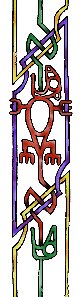 Long ago, it is believed that an Exile came to Sinai, of a species known
as a "mongoose", bearing physical resemblance to Sinai's race of Kavis.
This Exile was a skilled fighter, but most curious was that he was a
specialist in killing Nagas. On his homeworld, apparently there was enmity
between this race of "mongooses" and a race of Naga-like beings. This
Exile brought his teachings to Sinai, and preached to the Kavi he found,
spreading the word of Rik'.
Long ago, it is believed that an Exile came to Sinai, of a species known
as a "mongoose", bearing physical resemblance to Sinai's race of Kavis.
This Exile was a skilled fighter, but most curious was that he was a
specialist in killing Nagas. On his homeworld, apparently there was enmity
between this race of "mongooses" and a race of Naga-like beings. This
Exile brought his teachings to Sinai, and preached to the Kavi he found,
spreading the word of Rik'.
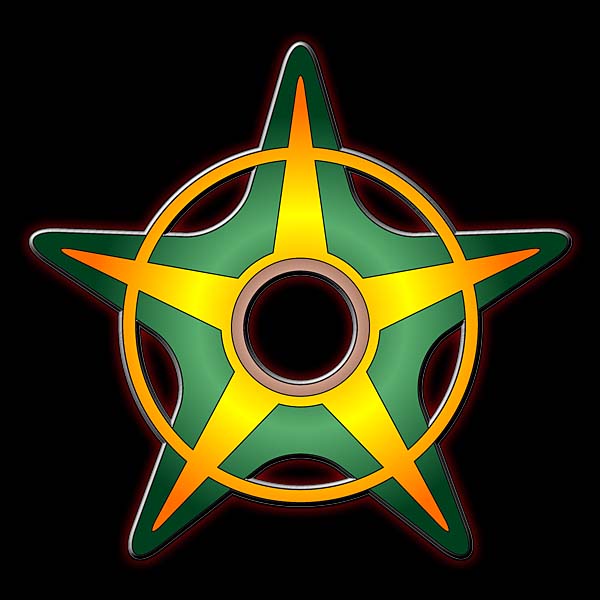 The symbol of the Great Gear is, of course, a large gear. It is typically
portrayed as having five spokes in an arrangement that makes it look like
a five-pointed star (encouraging further comparisons with the worship of
the Star).
The symbol of the Great Gear is, of course, a large gear. It is typically
portrayed as having five spokes in an arrangement that makes it look like
a five-pointed star (encouraging further comparisons with the worship of
the Star).
9.6 Cultists of Bosch
 Nothing is really known what goes on in Aeztepa, but there are scattered
cults -- particularly amongst mages who practice forbidden arts -- that
revere and/or fear an entity known as Necropolis, associated with the
land of Aeztepa. Terminology in these ancient texts are a bit unclear on
the identity of Necropolis, identifying it both as a place and as a power,
and the distinction between Necropolis and Amenlichtli -- known as the
"Queen of the Dead" and the "Queen of Necropolis" -- is blurred.
("Necropolis" means "City of the Dead".) Some
texts refer to Amenlichtli as being Necropolis. (However, that is perhaps
not far removed from some feudal concepts of "The King and the Land are One".)
Nothing is really known what goes on in Aeztepa, but there are scattered
cults -- particularly amongst mages who practice forbidden arts -- that
revere and/or fear an entity known as Necropolis, associated with the
land of Aeztepa. Terminology in these ancient texts are a bit unclear on
the identity of Necropolis, identifying it both as a place and as a power,
and the distinction between Necropolis and Amenlichtli -- known as the
"Queen of the Dead" and the "Queen of Necropolis" -- is blurred.
("Necropolis" means "City of the Dead".) Some
texts refer to Amenlichtli as being Necropolis. (However, that is perhaps
not far removed from some feudal concepts of "The King and the Land are One".)
 The theology of the Hekoye centers around their god, Shung Matu, who is seen as less than benevolent,
more of a prankster god who seems to delight in bringing misery to his creations. However, the Hekoye
accept all of this with reservation of passion, as their lot in life. Even those who master the magical arts
of Sinai, they believe, are not spared from the trickery of Shung Matu.
The theology of the Hekoye centers around their god, Shung Matu, who is seen as less than benevolent,
more of a prankster god who seems to delight in bringing misery to his creations. However, the Hekoye
accept all of this with reservation of passion, as their lot in life. Even those who master the magical arts
of Sinai, they believe, are not spared from the trickery of Shung Matu.