Sinai has several different beasts that fill the role of mount or pack animal. Of these, dromodons are the most common, followed closely by drokars. The average Rephidimite may not even know about most of the others.
1.1 Drokars
1.2 Dromodons
Dromodons have thick hides, offering them some modicum of protection against
the claws of wild beasts, or even against arrows of bandits, making them
favored beasts to pull wagons for caravans going through unfamiliar
territory. Also, despite their quasi-reptilian features, they are actually
warm-blooded, making them useful in colder climates.
1.3 Kooshkies
While they normally travel just under the surface of the sand, they are also
capable of leaping considerable distances and bouncing or even rolling along
the dunes. They are playful creatures at times, apparently showing affection
to each other by bounding into the air and crashing into each other, making
a distinctive "koosh" sound when they do so. Otherwise, they are completely
silent.
Largely, the Kooshkies are prey to various desert denizens, but teams of them
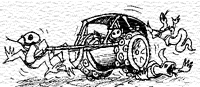
may be captured and trained by Nohbakims to draw Kooshkie Sleds. At times,
Kooshkie sleds can be seen trailing across the desert, drawn by unseen mounts,
with a Nohbakim standing on the sled, cracking a whip in the air and yelling,
"Hooska, Kooshkies! Hooska!" The word "Hooska" appears to have no other use
in the language of the Nohbakim, and its meaning is not even known for sure by
the Nohbakim (though they are never short on opinions).
1.4 N'gyahs
N'gyahs are another type of beast of burden, resembling cartoony
versions of horses, with lumpy proportions and legs that suggest those
of an elephant in their roughly cylindrical shape. N'gyahs are
true mammals, and grow thick shaggy coats in the winter, making them
more adaptable to the colder climates of the far north and far
south than pseudo-reptiles like Drokars and Dromodons.
1.6 Pteras
1.6 Rakhtors
1.7 Sea Kings
Not all beasts of burden are meant for use on land.
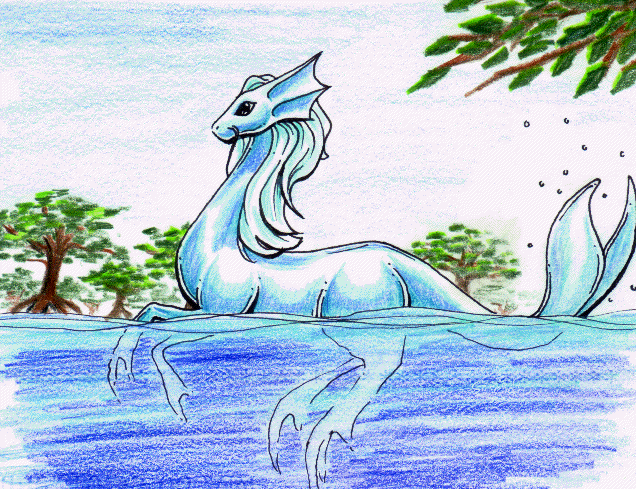
Sea Kings are totally restricted to the water, looking
like nothing so much as giant versions of seahorses, though with
slightly varied proportions. Sea Kings are sometimes used as
mounts, or else in large teams to pull cargoes through the water.
1.8 Selonas
One "hazard" that may be encountered by a rider of a selona rickshaw is that,
if two male selonas should happen to approach each other head on, they will come to a halt and then start engaging in a head-bobbing contest, trying to look
bigger and tougher than each other, much to the chagrin of a driver trying to
keep them moving.
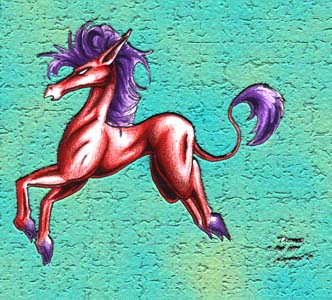 Drokars are pseudo-reptilian quadrupeds with mammalian features. They are
"dragon-horses", resembling equines, but with fine,
elongated features, and exotic coloration, often used as riding
beasts, but expensive to maintain. They generally require a large pasture
to roam and graze in, and therefore are not often seen in Rephidim, except
when used by the especially wealthy and elite. On the surface, they are
prized mounts, and sometimes used in teams to draw carriages.
Drokars are pseudo-reptilian quadrupeds with mammalian features. They are
"dragon-horses", resembling equines, but with fine,
elongated features, and exotic coloration, often used as riding
beasts, but expensive to maintain. They generally require a large pasture
to roam and graze in, and therefore are not often seen in Rephidim, except
when used by the especially wealthy and elite. On the surface, they are
prized mounts, and sometimes used in teams to draw carriages.
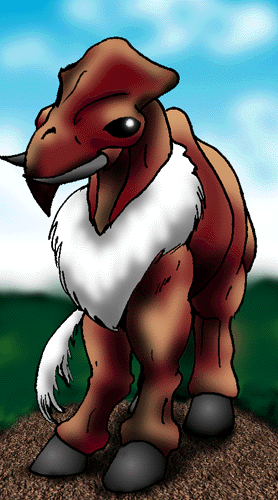 Dromodons are hardy beasts, used to pull wagons or plows, and
occasionally as mounts in especially rugged terrain. It is believed that
they store water and nutrients in the large humps on their backs, allowing
them to go for great periods without sustenance in some of the more barren
regions. Some varieties of dromodons are also raised as livestock.
Dromodons are hardy beasts, used to pull wagons or plows, and
occasionally as mounts in especially rugged terrain. It is believed that
they store water and nutrients in the large humps on their backs, allowing
them to go for great periods without sustenance in some of the more barren
regions. Some varieties of dromodons are also raised as livestock.
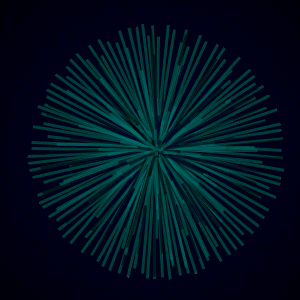 Kooshkies are strange creatures found in the Sea of Sand that "swim" through
the sand at high speeds by means of semi-prehensile flagellate limbs that
radiate out from their tiny core bodies. Their means of reproduction and of
sustenance is as of yet unknown and defiant of study, as Kooshkies
unfortunately do not survive for long in captivity.
Kooshkies are strange creatures found in the Sea of Sand that "swim" through
the sand at high speeds by means of semi-prehensile flagellate limbs that
radiate out from their tiny core bodies. Their means of reproduction and of
sustenance is as of yet unknown and defiant of study, as Kooshkies
unfortunately do not survive for long in captivity.
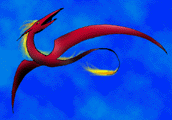 Pteras are winged pseudo-reptilians that can be found over a wide range
over Sinai, even more so since they are favored for beast-drawn airships.
They are prized for their tolerance of temperature extremes, their
exceptional endurance, and also that they can be trained. They can be
found "wild" in any number of areas on Sinai, as well as occasionally
roosting on the smaller sky islands.
Pteras are winged pseudo-reptilians that can be found over a wide range
over Sinai, even more so since they are favored for beast-drawn airships.
They are prized for their tolerance of temperature extremes, their
exceptional endurance, and also that they can be trained. They can be
found "wild" in any number of areas on Sinai, as well as occasionally
roosting on the smaller sky islands.
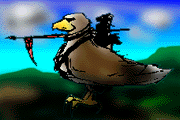 When traveling by air, the beasts of burden of choice are the large
avians known as Rakhtors (alternate spelling: Raktors). These
great, carnivorous birds are quite ferocious and dangerous when
found in the wild, but if raised from the point of hatching, they
can be trained to carry riders, or to work in groups to ferry
airborne "carriages" from point to point when an airship won't
suffice.
When traveling by air, the beasts of burden of choice are the large
avians known as Rakhtors (alternate spelling: Raktors). These
great, carnivorous birds are quite ferocious and dangerous when
found in the wild, but if raised from the point of hatching, they
can be trained to carry riders, or to work in groups to ferry
airborne "carriages" from point to point when an airship won't
suffice.
 These almost horse-sized, swift-footed lizards can be found in abundance
in some areas of the Savan Territories, capable of climbing up the gigantic
trees found in the jungle territories, or scaling rocky cliffs. In the
cities of the Nagai Empire, they are rigged up to rickshaws (with suction-cup
wheels) and used as a fairly reckless means of fast transportation through
the urban environment. (May the pedestrian beware!)
These almost horse-sized, swift-footed lizards can be found in abundance
in some areas of the Savan Territories, capable of climbing up the gigantic
trees found in the jungle territories, or scaling rocky cliffs. In the
cities of the Nagai Empire, they are rigged up to rickshaws (with suction-cup
wheels) and used as a fairly reckless means of fast transportation through
the urban environment. (May the pedestrian beware!)
2.0 Waashu
Waashu have hanging tentacles that have paralyzing stingers on the
ends, much like more familiar jellyfish. The stingers are primarily
used for reflexive defensive purposes, while the tentacles are used to
gather in their food -- which is generally anything they can reach.
For this reason, particularly large Waashu can be a hazard to airships
who might blunder into them in dense cloud cover, as the giant gasbags
will immediately try to grapple for the ship and anything on it.
Rarely does a Waashu get much of a meal out of this, but many a ship
has been destroyed by such encounters.
In regards to how one combats the Waashu, fire is the weapon of
choice. While it is not all that easy to penetrate the rubbery hide of
a living Waashu, the gases inside prove to be very flammable. It is
also often possible to ignite a gasball in the vicinity of the Waashu,
sometimes sufficient to drive it away. However, once the Waashu is
within close range of the ship, this tends to be a very suicidal
method. The hide of a living Waashu has limited self-sealing
abilities, and it has multiple "sacs" inside, so simply puncturing it
with, say, arrow fire, will generally have little more effect than to
make the odor worse. However, no better method of saving an entangled
ship is yet known -- short of a suicidal gesture or magic -- than to
riddle it with arrow fire and cut and hack at it until hopefully it
might slip free and sink as the gases escape.
At times, dead Waashu may be spotted, and it is hard to tell from a
distance the difference between a living and dead one. In general, the
skin of the Waashu becomes more opaque and dark, and is also more
easily punctured. The Waashu may float for many days, even weeks,
before eventually the build-up of gases and weakening of its hide is
such that it simply bursts and collapses inward, falling to the ground
below. (The sound of this event, as it is reported but rarely
witnessed, sounds much like giving one the "raspberries". The odor is
reputedly unbearable.)
Near as can be told, Waashu are no more intelligent than plants, and
no brain can be found in dissected corpses. Smaller Waashu are
sometimes preyed upon by iron-bellied airborne carnivores, and can be
found in cloud-like swarms during the short period after being ejected
upon "birth", before being dispersed by the winds. At this stage,
their stingers are not all that potent, and there are tall tales and
jokes told of starved airship sailors over the oceans who harvested a
cloud of these things and ate them, only to begin floating away once
full of the little creatures.
"Waashu sauce" is famed as being among the spiciest available anywhere,
though sometimes the term is used to describe a spicy concoction that
may or may not actually contain Waashu extracts.
3.0 Sky Gardens
The Waashu are not alone insofar as natural-born gasbags to be found
on Sinai. There are many varieties of plants that disperse their
seeds -- or seedlings -- by not so dissimilar methods. The result is
what looks like a floating clump of vegetation, bouyed by thin-skinned
"melons" containing lighter-than-air gases. These membranes are not
quite so air-tight, and the gases will eventually seep out, causing
the seedlings to descend after being borne upon the wind for many
miles. Some are indeed edible, and may bear fruit, vegetables or nuts.
Insofar as the Waashu are concerned, all of these are edible, and
comprise most of their diet. (After all, Sky Gardens don't try to
escape, and don't put up much of a fight once absorbed, either.) One
must be careful when munching on Sky Gardens, of course -- there are
varieties that are poisonous to varying degrees. One must be
especially careful about the various types of berries.
Then, there
are also tales of those who, lacking common sense, cut into the
"exploding melons". Smaller "pop-berries", however, not having enough
buoyance to actually float on their own, are often considered a fun
(if short-lived) toy for airship sailors to bring back to their
youngsters. Unlike Waashu, floating plants aren't generally
accompanied by disagreeable odors.
At certain times of the year, in agreeable climes, sometimes one can
see vast clusters of flower-bearing floating seedlings, hence the name
"Sky Garden".
(Tales are also told of not-so-bright airship sailors
who, upon finding a big conglomerate of sky seedlings, mistook it for
a floating island, swung their ship about, then leapt onto the
"island", only to plummet to their dooms far below. Airship sailors
really get a rough time in these stories.)
There are also variations of Sky Gardens believed to float over the
Nordikan wasteland territories known as the Wandering Roams. These
Sky Gardens shed small leaves that contain seedlings and nutrients,
some of which may find purchase in a rare patch of fertile ground in
the Roams and eventually spawn another Sky Garden. Some bands of
nomads, such as the Xients, roam after these Sky Gardens, subsisting
largely off of the organic matter that rains to the ground, their
travels dictated by the movements of the wind.
4.0 Pests
Sinai has its share of familiar pests: non-morphic rats and mice, flies,
fleas, ticks, mosquitos, and so forth. However, it also has a few more
exotic nuisances:
4.1 Blood Flies
The best defense against Blood Flies (other than simply never bleeding) is to
keep moving. They track by scent, not sight, so even if a swarm is in the same
clearing, there is still hope to get moving, and hope to find water. Getting
into water is the second method -- On the one hand, washing away blood helps.
On the other, Blood Flies drown very easily, and the best way to save a victim
covered with the flies is to dunk him quickly.
4.2 Chigas
These are tiny biting insects found widely distributed in the Savan, named
after mythical Nagai demons. The sap of the thistlebark tree has been found to
be an effective repellent against these creatures.
4.3 Jeebits
5.0 Cattle
Sinai has a number of different types of beasts raised for meat,
including:
5.1 Bromthen Forest-Hogs
5.2 Chibix
While Chibix wings are very fragile, the creatures themselves are
shelled, and have some ability to regenerate (slowly), making them
fairly hardy. They tend to be about the size of true bats, though there
are rumors that in some regions they may reach truly legendary wingspans.
In the Ashdod Territories, they are raised as a food staple by
the Eeee. Some Eeee nobles consider it a delicacy to pluck the
wings from a chibix, then pry loose its shell and eat from its fatty
hump, while the creature shrieks loudly, making a "pleasing" sound.
5.3 Rughrats
Rughrats are six-legged hairy beasts that are
cow-like in general appearance and disposition. Rughrats are considered
as being native to the continent of Ur, especially in the lowlands of
the Ashdod Territories, where large herds are shepherded by the
Eeee and the Fnerfs. Smaller farms are occasionally found elsewhere,
where Rughrats are raised for meat, milk and for their hairy hides.
5.4 Shikk'ahn
Native to the plains of Saskanar on the
western side of the Ashdod Territories, these creatures somewhat
resemble velociraptors, and are quite ferocious in the wild ... but
it was discovered that they make for pretty good eating, and they have
subsequently been domesticated. The domesticated versions have their
killing claws either bred out or removed, and are fairly docile, unless
they've not been fed in a week.
6.0 Foodstuffs
While many of the types of grain, vegetables and fruits that can be
found on Earth are also found on Sinai, there are a number of food
products that are unique to Sinai.
6.1 Bromthen Pumpkin-Truffles
This oversized "truffle", the size of a pumpkin as the name suggests, is found
exclusively in the jungles of the Savan. It is associated with the Bromthen
Forest-Hog, which is its primary "predator", for the oversized boar-like
creatures are unsurpassed at sniffing out and digging up these growths with
their enormous tusks.
In appearance, the truffle looks like a giant, hairy pumpkin. The outer husk
is thick and durable, requiring some effort to break. The inside consists of
nodules of a carob-like substance. Pumpkin truffles are sometimes sought out
as delicacies, but their relative rarity and the lack of ease in finding them
makes them even more a rarity on anyone's dinner plate (except, perhaps, that
of a Bromthen Forest-Hog...).
Sometimes Forest-Hogs have been used to root out these truffles, but
(unfortunately for truffle connosieurs and for the Forest-Hog), the boar-like
creature is rather tasty as well, and his ivory tusks are far more valuable
than any truffles ... so he's not likely to be kept on as a pet. (Besides,
Bromthen Forest-Hogs are impossible to truly "tame".)
6.2 Kyootcumber
Kyootcumbers are spicy vegetables that grow on vines in abundance on
the undersides of the sky islands, and thus are harvested by fliers.
While not as spicy as "Waashu sauce", various kyootcumber extracts
are used to flavor foods, especially in Rephidim (since there is a
ready supply on the Underside).
6.3 Lovan
Lovan fruits can be found in the Savan Territories, cantalope-sized melon-like
fruits that grow on vines, and which have a spongy, bread-like interior with
light coloration. The fruit is more or less tasteless, but in especially arid
seasons, water collects in the spongy interiors, thus making it a good resource
for those short on water. Also, with some preparation, recipes using lovan
can make a pretty good substitute for bread or cake.
6.4 Mateh
7.0 Gooshurms and Zolk
This behavior is apparently based upon the Gooshurm's relationship with
another creature that shares its trilateral symmetry: the Burrowbit.
Burrowbits roughly resemble a cross between a giant worm and a mole,
digging underneath the ground. Burrowbits store nutrients (usually
fungus) in pouches inside their body. As a defense mechanism, when
attacked, Burrowbits basically expel their insides, allowing predators
to munch on them, and hopefully stuff themselves enough so that they
won't feel compelled to tear the Burrowbit to pieces in the process.
The Gooshurm obviously takes advantage of this process, simply seeking
out Burrowbits and then slobbering on them. The Burrowbit obligingly
expels its nutrients, and the Gooshurm consumes them, then flees.
Apparently, something about foxes must cause Gooshurms to mistake them
for Burrowbits.
Gooshurms are not mere pests, though. It is believed that they are
responsible for the creation of the material known as zolk. "Zolk
prospectors" sometimes traverse the Sea of Sand in the Himaat, in
search of patches of "zolk threads" that can be used in the process
of creating zolk fabric. There are several grades of zolk, the rarest
exhibiting amazing properties of durability. "Platinum" zolk, the
rarest variety, has a metallic white sheen, and is held to be highly
puncture resistant, somewhat like kevlar. Some believe that these
"zolk threads" are in fact sheddings from the stomach linings of
Gooshurms, as the sand wears away at their insides while they sift
the sand for nourishment.
8.0 Pets and Guard Animals
While some people will try to make a pet out of just about anything, there
are still a few creatures that are the closest to "dog and cat" equivalents
for Sinai (or at least Rephidimite society), insofar as pets and "guard dogs"
go.
8.1 Beasthounds
8.2 Creens
They are insectivores, and some varieties
are capable of being taught to mimic sounds, much like parrots, hence making
them somewhat popular as exotic pets for those who can afford them.
8.3 Fuff'nars
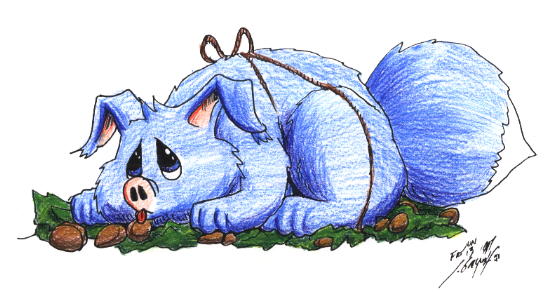
For some reason, many nobles have taken to procuring fuff'nars as pets. If
kept well fed, they've proven to be tame and affectionate -- although if
they go for any length of time without food, there's an excellent chance they'll
attack their owner. Thusly, when the fuff'nar owmer decides to take the pet for a walk...
it's a good idea to keep them muzzled.
Fuff'nars have one amazing trait; they can actually mimic a person's voice --
often repeating words said to it by the master. They tend to pick up words relating
to their lifestyle and scavenger nature, usually words like "dead" and "kill".
8.4 Groks
 Among the various sights and hazards to be found on the skyways, the
Waashu rank among the most dazzling yet potentially deadly. In short,
they are giant living gasbags, which look like gargantuan
semi-translucent rainbow-colored jellyfish which float on the winds at
high altitudes. Their movements are largely subject to the wind, but
they are capable of some maneuvering by means of sucking in gulps of
air and expelling it. (At a distance, Waashu may be pleasant to see.
Much closer, the odor suggests that of sulphur, and is disagreeable.)
Among the various sights and hazards to be found on the skyways, the
Waashu rank among the most dazzling yet potentially deadly. In short,
they are giant living gasbags, which look like gargantuan
semi-translucent rainbow-colored jellyfish which float on the winds at
high altitudes. Their movements are largely subject to the wind, but
they are capable of some maneuvering by means of sucking in gulps of
air and expelling it. (At a distance, Waashu may be pleasant to see.
Much closer, the odor suggests that of sulphur, and is disagreeable.)
 One of the more distasteful varieties of "fauna" to be found in the jungle
regions of the Savan and parts of the plains is the dreaded Blood Fly. These
creatures have an uncanny ability to scent blood as far as a mile away, and
will arrive in swarms in a matter of minutes (or less). In a sense, they serve
as "janitors" of the jungle, But, they are a genuine hazard to wounded
creatures. They swarm over fallen victims, blanketing them and cramming into
every available orifice, killing by suffocation. After that ... it's just
another meal.
One of the more distasteful varieties of "fauna" to be found in the jungle
regions of the Savan and parts of the plains is the dreaded Blood Fly. These
creatures have an uncanny ability to scent blood as far as a mile away, and
will arrive in swarms in a matter of minutes (or less). In a sense, they serve
as "janitors" of the jungle, But, they are a genuine hazard to wounded
creatures. They swarm over fallen victims, blanketing them and cramming into
every available orifice, killing by suffocation. After that ... it's just
another meal.
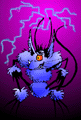 Jeebits are particularly malevolent (and small) creatures found in the
Wandering Roams (though preferably NOT found if it can be managed). They
are no larger than 6 inches in height, though on their surprisingly
powerful legs, they are capable of leaping several feet. They capture
prey by means of shocking them with their antennae. They also attack
creatures they have no intention of preying upon, for all intents and
purposes just to be annoying, for all anyone can tell. Despite this
malicious bent, they are apparently non-sapient.
Jeebits are particularly malevolent (and small) creatures found in the
Wandering Roams (though preferably NOT found if it can be managed). They
are no larger than 6 inches in height, though on their surprisingly
powerful legs, they are capable of leaping several feet. They capture
prey by means of shocking them with their antennae. They also attack
creatures they have no intention of preying upon, for all intents and
purposes just to be annoying, for all anyone can tell. Despite this
malicious bent, they are apparently non-sapient.
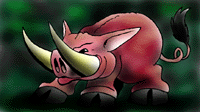 Despite the name, these large
boar-like creatures are not restricted solely to the territory of
Bromthen. They look like large, squat, distorted versions of boars,
with disproportionately large tusks. They are valued for their
meat and for the ivory of their tusks, but they are also sometimes
used to root out their favorite food -- the legendarily large
Pumpkin Truffles. These creatures are ill-tempered and strong,
though not particularly bright. Some attempts have been made to
raise them as livestock, but these are hazardous operations.
Despite the name, these large
boar-like creatures are not restricted solely to the territory of
Bromthen. They look like large, squat, distorted versions of boars,
with disproportionately large tusks. They are valued for their
meat and for the ivory of their tusks, but they are also sometimes
used to root out their favorite food -- the legendarily large
Pumpkin Truffles. These creatures are ill-tempered and strong,
though not particularly bright. Some attempts have been made to
raise them as livestock, but these are hazardous operations.
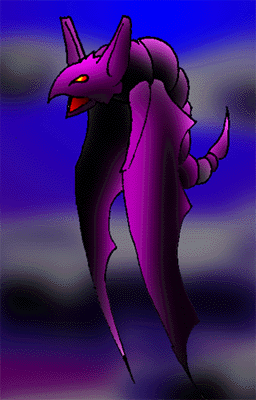 Chibix are nocturnal quasi-arthropods that fly on somewhat bat-like
wings, and feed on fruits and seeds, found scattered across the globe,
though mostly in more temperate climates. They are shelled creatures that
bear some remote resemblance to bats, and, indeed, in Rephidim Standard,
when one refers to "bats" in the generic, if one is not referring to an
Eeee, one is likely referring to one of these creatures.
Chibix are nocturnal quasi-arthropods that fly on somewhat bat-like
wings, and feed on fruits and seeds, found scattered across the globe,
though mostly in more temperate climates. They are shelled creatures that
bear some remote resemblance to bats, and, indeed, in Rephidim Standard,
when one refers to "bats" in the generic, if one is not referring to an
Eeee, one is likely referring to one of these creatures.
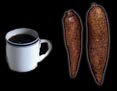 A small fernlike plant found in hot jungle regions
of Sinai and widely cultivated, Mateh's long, thin brown roots contain
caffiene. These roots are harvested, dry-roasted and ground. Boiling
water filtered through this powder will produce a dark, rich, slightly
bitter beverage that is usually sweetened with honey, sugarfir leaf,
or sugar. Cream or milk may also be added, as may xochlatl. Due to its
properties as a stimulant, a hot cup of mateh is enjoyed as a "wakeup"
beverage by many species able to tolerate caffiene. Mateh root also
varies in taste and aroma depending on its place of origin; certain
prized varieties will be more costly than a "common" variety such as
one might find in any low-priced inn.
A small fernlike plant found in hot jungle regions
of Sinai and widely cultivated, Mateh's long, thin brown roots contain
caffiene. These roots are harvested, dry-roasted and ground. Boiling
water filtered through this powder will produce a dark, rich, slightly
bitter beverage that is usually sweetened with honey, sugarfir leaf,
or sugar. Cream or milk may also be added, as may xochlatl. Due to its
properties as a stimulant, a hot cup of mateh is enjoyed as a "wakeup"
beverage by many species able to tolerate caffiene. Mateh root also
varies in taste and aroma depending on its place of origin; certain
prized varieties will be more costly than a "common" variety such as
one might find in any low-priced inn.
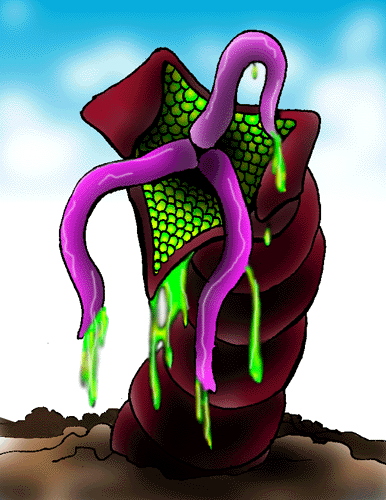 Gooshurms are large worm-like creatures found in the Himar Region on
the continent of Ai, either in the Himar Territories or portions of
the Himaat. They have trifiburcated mouths, and three prehensile
tongues, and a tendency to slobber excessively. They are best known
for burrowing underneath the soil, then popping up to assault foxes
and fox-like creatures, slobbering all over them and then
disappearing, leaving a dripping wet (and shocked) victim.
Gooshurms are large worm-like creatures found in the Himar Region on
the continent of Ai, either in the Himar Territories or portions of
the Himaat. They have trifiburcated mouths, and three prehensile
tongues, and a tendency to slobber excessively. They are best known
for burrowing underneath the soil, then popping up to assault foxes
and fox-like creatures, slobbering all over them and then
disappearing, leaving a dripping wet (and shocked) victim.
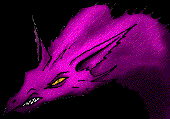 Beasthounds are dog-equivalent pseudoreptiles, having scaly hides
interspersed with sparse hairs, a ridge of sharp needle-like spines
down their backs (making the act of petting them very hazardous), and
muzzles that sport two triangle sets of sharp teeth. They are often
employed as guard-dogs, though they are a bit too temperamental (and
dangerous) to be used as true pets on any wide basis.
Beasthounds are dog-equivalent pseudoreptiles, having scaly hides
interspersed with sparse hairs, a ridge of sharp needle-like spines
down their backs (making the act of petting them very hazardous), and
muzzles that sport two triangle sets of sharp teeth. They are often
employed as guard-dogs, though they are a bit too temperamental (and
dangerous) to be used as true pets on any wide basis.
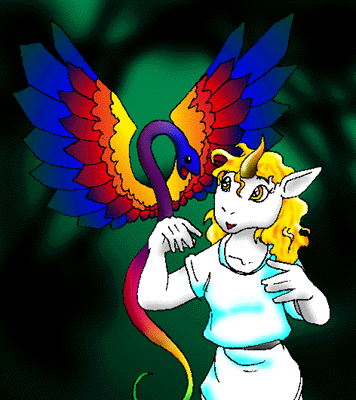 Creens are small serpentine lizards with feathered wings and sometimes tail-plumes in
bright, festive colors. They are found in many colors and varieties in tropical
areas, especially in the jungles. They are found on all of the major continents,
not constrained to a particular region.
Creens are small serpentine lizards with feathered wings and sometimes tail-plumes in
bright, festive colors. They are found in many colors and varieties in tropical
areas, especially in the jungles. They are found on all of the major continents,
not constrained to a particular region.
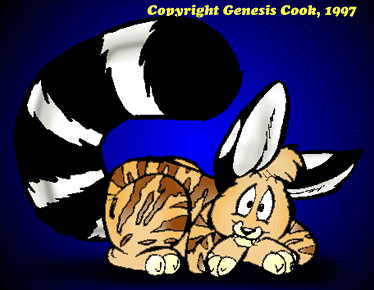 Native to Lamu, but found in many areas all across Sinai, the fuff'nars are very
odd creatures. Their appearance can best be described as 'cute'. They are about a foot
to a foot and a half long, followed by a ringed tail that is equal to their bodies
in length. Fur color is tawny beige, with reddish brown stripes marking their
back and legs. Scavengers by nature, they usually travel in small packs
and live off the pickings of larger predators. They are capable of bringing
down their own prey if their numbers are great enough in a particular pack.
Native to Lamu, but found in many areas all across Sinai, the fuff'nars are very
odd creatures. Their appearance can best be described as 'cute'. They are about a foot
to a foot and a half long, followed by a ringed tail that is equal to their bodies
in length. Fur color is tawny beige, with reddish brown stripes marking their
back and legs. Scavengers by nature, they usually travel in small packs
and live off the pickings of larger predators. They are capable of bringing
down their own prey if their numbers are great enough in a particular pack.
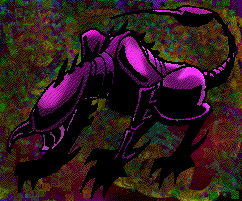 Groks are quasi-insectoid "dog"-type creatures domesticated by the Eeee of the Ashdod Territories (and also found running wild in the wilderness). They are completely blind, having no eyes, but have keen senses of smelling, hearing, and are very sensitive to air movements that hint at the presence of prey or intruders. They are reasonably well-armored, with chitinous shells, but are not very bright.
 Vermites resemble, more than anything else, a cross between a rat and some
manner of hairy insect. They are found widely over Sinai, even somehow on
the sky islands, and are greatly hated pests, often carrying disease. Only
those with the most hardy of countenances can actually eat them without
getting sick.
Vermites resemble, more than anything else, a cross between a rat and some
manner of hairy insect. They are found widely over Sinai, even somehow on
the sky islands, and are greatly hated pests, often carrying disease. Only
those with the most hardy of countenances can actually eat them without
getting sick.
 These sluggish, lumpy creatures don't look
particularly appetizing, and have a consistency of gristle. However,
their bodies are capable of regenerating most of their flesh, as long
as the poisonous green head is not consumed. Due to the amazing
resilience of these disgusting little creatures from the Savan, they
are sometimes used as field rations.
These sluggish, lumpy creatures don't look
particularly appetizing, and have a consistency of gristle. However,
their bodies are capable of regenerating most of their flesh, as long
as the poisonous green head is not consumed. Due to the amazing
resilience of these disgusting little creatures from the Savan, they
are sometimes used as field rations.
 This fruit bearing tree can be found in many varieties in oases of the Himaat
and other arid regions. It is distinguishable by having tiny leaves and
similarly tiny fruits as well. The trees do not grow in great numbers, and
therefore the fruit is fairly rare, since it is a very "finicky" plant if raised
outside its natural habitat. Therefore, the fruit of this tree is somewhat
rare and is considered mostly a "delicacy" and food of the wealthy.
This fruit bearing tree can be found in many varieties in oases of the Himaat
and other arid regions. It is distinguishable by having tiny leaves and
similarly tiny fruits as well. The trees do not grow in great numbers, and
therefore the fruit is fairly rare, since it is a very "finicky" plant if raised
outside its natural habitat. Therefore, the fruit of this tree is somewhat
rare and is considered mostly a "delicacy" and food of the wealthy.
 Mostly associated with the territories of
Aelfhem, Sugarfir trees have black bark, offset by bright pink leaves.
These leaves have seedling bulbs in the base removed, and are then
ground up to provide a popular sweetener. Groves of Sugarfir are
grown for this purpose in the Ashdod Territories, though it's held
that the rare varieties cultivated in Aelfhem are of superior
quality.
Mostly associated with the territories of
Aelfhem, Sugarfir trees have black bark, offset by bright pink leaves.
These leaves have seedling bulbs in the base removed, and are then
ground up to provide a popular sweetener. Groves of Sugarfir are
grown for this purpose in the Ashdod Territories, though it's held
that the rare varieties cultivated in Aelfhem are of superior
quality.
 Alternate name: "Blue-Hunter".
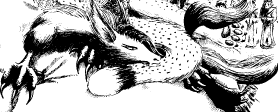
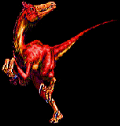 Vanderats are, in short, furry velociraptors that come in a wide variety of colorful markings, and which are raised and bred for their speed, found in the lands of the Khattan Emirate of the Himaat.